Showing posts with label AI. Show all posts

Monday, 15 May 2023

Unlocking the Potential of AI-Based Technology


Unlocking the potential of AI-based technology

4 billion+ devices already work on AI-powered voice assistants (source: connect.comptia.org). This clearly suggest how widely AI-based technology is being used. In recent years, AI-based technology has revolutionized how businesses operate, with its ability to streamline operations, enhance efficiency, and improve decision-making. Unlocking the potential of AI-based technology can give organizations a competitive advantage, enabling them to make better-informed decisions, improve productivity, and reduce costs. This article will explore the benefits of AI-based technology and how it can be effectively utilized to drive business growth and success.

What is Artificial Intelligence?

The simulation of human intelligence processes by machines, particularly computer systems, is known as artificial intelligence. Expert systems, natural language processing, speech recognition, and machine vision are examples of AI applications.

Artificial intelligence-focused cognitive abilities

Learning: This element of AI programming is concerned with gathering data and developing rules for turning it into usable information. The rules, known as algorithms, teach computing equipment how to execute a certain task step-by-step.

Reasoning: This part of AI programming focuses on selecting the best algorithm to achieve results.

Self-correction: This element of AI programming is intended to fine-tune algorithms to produce the most accurate results constantly.

Creativity: This branch of artificial intelligence employs neural networks, rules-based systems, statistical approaches, and other AI techniques to generate new images, text, music, and ideas.

Read More>>

Sunday, 22 January 2023

5 Ways Cloud Computing Is Getting Smarter With AI

In a recent report, Statista predicted that by 2025, “the global value of the AI market will surpass an estimation of $89 billion per annum by 2025.” The study contends that a sizeable portion of this will occur due to the accelerated demand for Artificial Intelligence (AI) that powers Cloud computing. Artificial intelligence (AI) and cloud computing have a daily impact on millions of people’s lives in today’s digital world. Every day, digital assistants like Siri, Google Home, and Amazon Alexa demonstrate the power of AI and cloud computing. A seamless operation of verbal commands or data backup over emails, and cloud drives, showcases how AI and cloud-based resources are improving our daily lives. 

Blend of Cloud & AI

On the business side, AI technology, coupled with cloud computing, is making organizations become more efficient, strategic, and insight-driven. With the Cloud comes more flexibility, agility, and cost reduction, while artificial intelligence allows for better data management, analytics, and insights, improving customer experience and workflow optimization.

While it is well known that AI works on the ideology that machines can mimic human intelligence and can be programmed to think and act like humans, blending it with Cloud Computing has proven to be quite beneficial for businesses and organizations. With faster innovation, flexibility, agility, and scalability than any other platform, cloud computing—which is the delivery of computing services like servers, storage, databases, networking, software, analytics, and intelligence—ensures better business growth.

Experts believe that AI has the potential to revolutionize cloud computing services. AI as a service improves Cloud Computing and opens up new avenues for innovative development. Merging cloud technology and AI is an indispensable component of business and commerce in the modern world. Better data management, storage, organization, optimization, and real-time insights are made possible by the seamless, adaptable environment it creates. A significant reduction in infrastructure management enables businesses to be more agile, flexible, and cost-efficient, improving the day-to-day experience.

The integration of AI infrastructure with public, private, and hybrid clouds offers many advantages, including:

  • Enhanced Data Management
  • Better Security
  • Intelligent Automation
  • Accelerated Productivity
  • Deeper Actionable Insights
  • Cost-Effectiveness
  • Reliability

The future belongs to AI and cloud computing. In many ways, it will revolutionize data management, storage, and processing. The five ways artificial intelligence enhances cloud computing are listed below:

Read More>>

Thursday, 12 January 2023

15 Latest trends in data center security 2023: Staying secure in the cloud

 Are you aware the average cost of a data breach in the cloud is $1.25 million? Isn’t that a considerable amount?

Latest Trends in Data Center Security

What would you better prefer? Waiting until it’s too late and spending on a data breach or instead on cloud data security?

Data insecurity shouldn’t be your downfall – protect it.

Data Center Security market

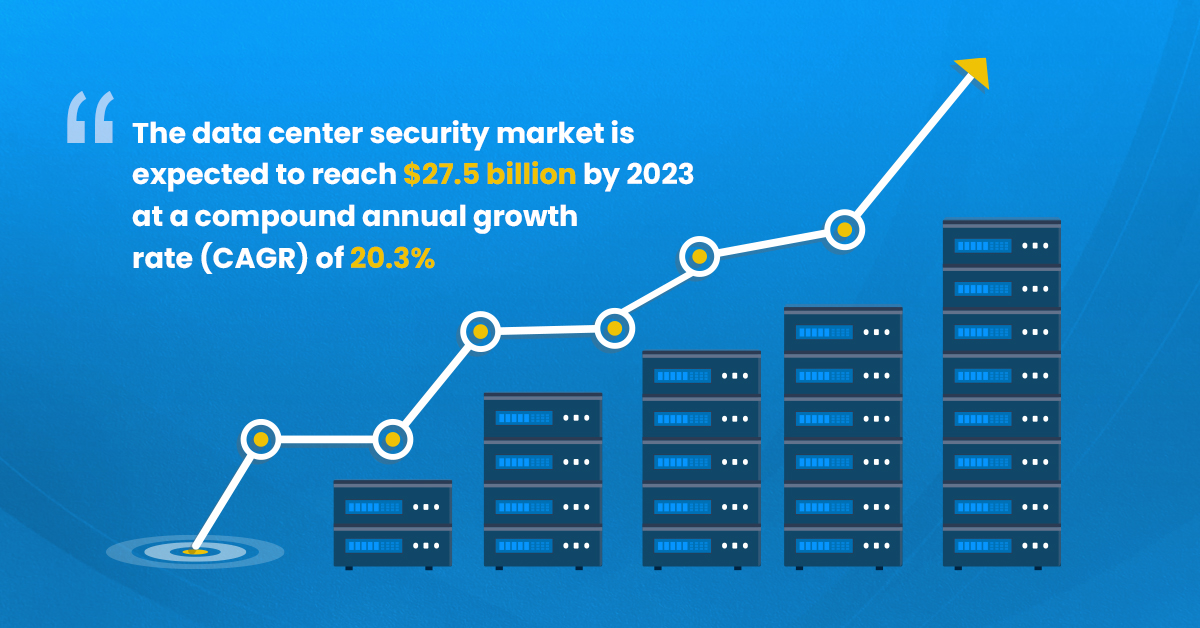
Talking about the Datacenter security market, the stats say, “The data center security market was valued at $11.1 billion in 2018 and is expected to reach $27.5 billion by 2023 at a compound annual growth rate (CAGR) of 20.3% during the forecast period.”

According to these projections, the data center security market is expanding rapidly and is anticipated to expand further in the forthcoming years. In addition, the increased usage of cloud computing and virtualization, as well as growing concern about data security and regulatory compliance, are projected to propel the data center security industry forward.

The data center security market is constantly evolving to keep pace with the changing threat landscape and the increasing adoption of cloud computing and virtualization.  Here are the 15 latest trends in the data center security market:

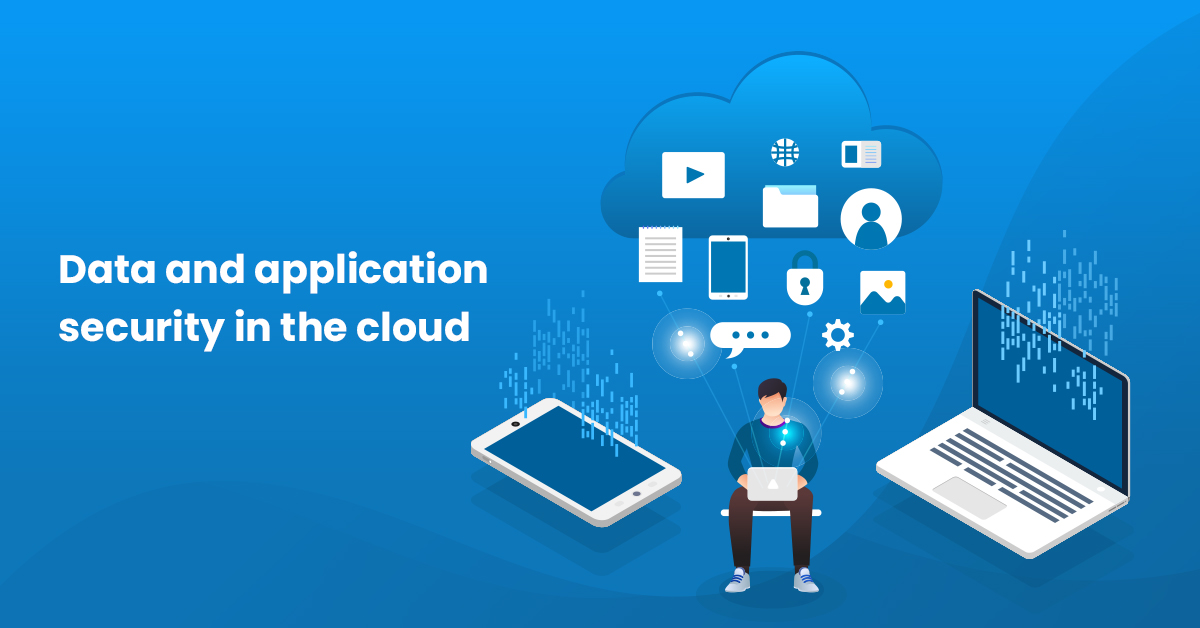
Data and application security in the cloud
  • Cloud security: With the increasing adoption of cloud computing, organizations are looking for ways to secure their data and applications in the cloud. This has led to the rise of cloud security solutions for cloud-based data centers. Cloud security is essential for any organization that uses cloud computing services to store, process, and manage data and applications.
  • Virtualization security: Virtualization security is securing virtualized environments, including virtual machines and the hypervisor, against cyber threats. Virtualization has become increasingly popular in data centers as it allows organizations to run multiple virtual servers on a single physical server, thereby increasing efficiency and reducing costs. However, virtualization also introduces new security challenges, such as the need to secure virtual machines and the hypervisor. As a result, there is a growing demand for virtualization security solutions.

Read More>>

Tuesday, 29 November 2022

Application Modernization – Why is it a must for your business?

Application modernization is the process of repurposing, restructuring, or consolidating existing business applications to better match their requirements with those of the market and its competitors. A legacy app can be made more modern by upgrading its technology stack, improving its application architecture, moving to a new, more current platform, or simply adding cutting-edge functionality using edge technologies.

Application Modernization

The majority of firms believe that modernizing applications is only necessary for organizations using outdated legacy systems. However, it is a presumption that needs to be disproved to confine modernization to legacy apps.

Applications that are out-of-date or on the approach of expiring cannot be the only ones that are modernized. Even a recently developed enterprise application might be seen through a more contemporary and futuristic lens. It makes sense that today’s freshly released enterprise systems are also aiming for digital transformation by developing into next-generation apps or augmenting into business- and customer-centric processes and applications that use AI and VR.

It makes sense that the market for application modernization services is expected to increase from $11.4 billion in 2020 to $24.8 billion in 2025. Undoubtedly, it is now a top issue for many business owners.

Still not convinced that modernizing applications is a good idea? Continue reading to learn more.

Why does your business need to modernize applications?

The term “digital transformation” has gained popularity in recent years. However, as most companies discovered the value of being digitally present to meet the needs of clients who are digitally conscious while physically distant, the epidemic increased its use. Companies moved even closer to this after Microsoft said it would “see two years’ worth of digital transformation in two months.”

However, enterprises seeking digital transformation face significant difficulty due to the monolithic design used by outdated systems. In a time when business applications were thriving in Low-Code/No-Code settings, these programs were still running on dated, heavy technologies. While more recent programs employed microservices and APIs to communicate with one another, even the smallest third-party integration for these legacy systems required complete development teams. Businesses obviously needed a makeover. Application modernization provided this, too.

Read More>>

Sunday, 6 November 2022

Significance of Data Fabric Solutions and Addressing the Challenges in Data Management

As data is becoming precious and gaining more importance by the hour, what are the challenges faced to ensure proper integration and security? While businesses are investing heavily in data management solutions in terms of finances, tools, and manpower, they are also exploring other ways to manage the data. With the unpredictable market landscape, businesses need a comprehensive range of solutions that can resolve issues of time, location, storage space, or any software related to data management. Since remote work has become the new normal, data accessibility from anywhere is also another requirement and safer data transport. In order to thrive in the competitive market, Data Fabric provides businesses with an efficient, more secure, future-proof unified environment solution. As security has become the biggest concern for businesses across all sectors, measures for data protection have increased. In terms of data storage, segregation, and further division as per its use at every step security is needed utmost. With data fabric in consideration, security is ensured with ease of access and management.
Data Fabric Solutions ESDS 1

Advanced technology such as the Internet of Things (IoT), Artificial Intelligence (AI), development, and progress in the cloud spectrum with hybrid cloud, edge computing, and other cloud computing solutions have gained much success over the past decade. The overall cloud sector itself has seen remarkable growth, especially since the pandemic, and has promising figures for the future. With all this, the rise of big data has also picked up, and with end-to-end integration of data pipelines, the cloud environments using AI and automated systems data fabric as an architecture method seem to be a promising solution. For data management teams the hurdles such as unification and administration have always been a concern of priority along with security risks, and data silos, among others. Capitalizing data fabric solutions to the hurdles of data systems, embedding administration, and strengthening the security and privacy measures that provide increased and better accessibility to the data for everyone concerned. In order to help organizations to solve complex data problems irrespective of the data environment, location, or platforms, data fabric provides solutions in real-time worldwide. The importance and necessity of ease of data accessibility have become a priority that needs to be addressed. This accessibility at ease can be achieved with proper unification of the data, with this not only one but multiple users can get access, and also it avoids data duplication and deletion.

Read More>>

Monday, 4 April 2022

Applications & Benefits of AI in Banking

AI is a technology that has impacted every industry vertical including the banking and finance sector. AI in banking reduces expenses by boosting productivity and making the decision process fast, and accurate. According to a report by Business Insider, almost 80%of banks are aware of the potential benefits of AI in the banking sector. It also says that by 2023, banks are estimated to save roughly $447 billion by deploying AI applications. The applications of AI in banking are many and so does the benefits of AI in banking.  Let’s take a look at some of them.
AI in Banking

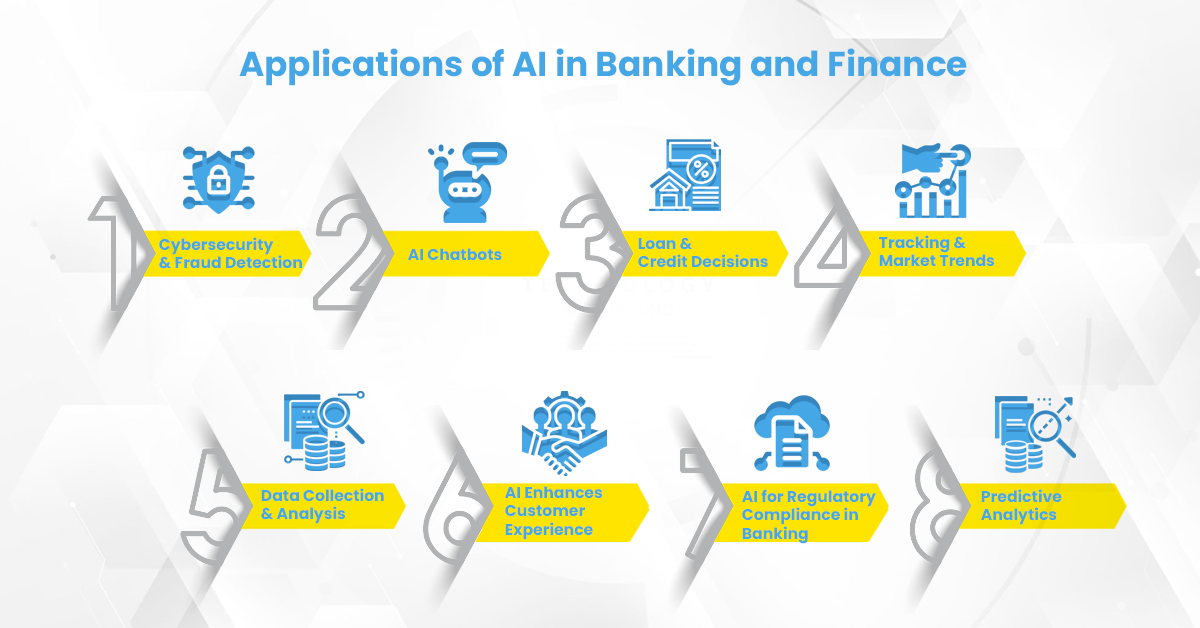
Applications of AI in Banking and Finance

Initially, AI was majorly used for increasing operational efficiency. This has changed post-pandemic where AI is used for automating processes and deriving insights. Here are the 8 major applications of AI in banking.

Applications of AI in Banking and Finance

Cybersecurity & Fraud Detection

AI along with machine learning is capable of easily identifying fraudulent activities and alerting customers and banks. In 2019, the financial sector was the most targeted industry for cyberattacks accounting for 29% of the total. AI can be a game-changer in the finance sector to stop cyberattacks. 

AI Chatbots

By combining chatbots with banking apps, the banks will be available for the customers round the clock 24*7. Chatbots’ capability to comprehend customer behavior helps in offering personalized customer support and recommending the right financial services and products accordingly.

Read More>>

Monday, 24 January 2022

The Fusion of Future Technologies – AI and Cloud Computing

Artificial Intelligence and Cloud Computing are considered the two most advanced technologies in a single theme.  Today, AI is becoming an indispensable component across every industry vertical, ranging from industries like Hospitals to Tourism. It is also proven that AI can be formulated to mimic a human and his behavior exactly.
The Fusion of Future Technologies

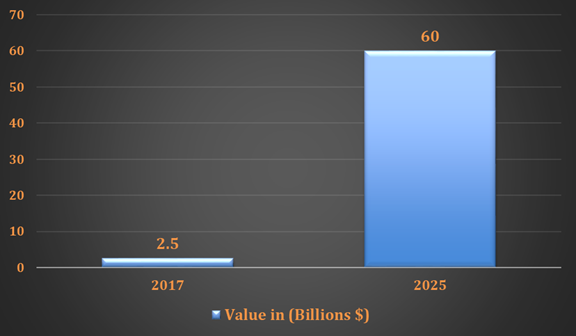
As per an online source, it is estimated that the overall AI market will be valued at $60 billion by 2025. The market was valued at $2.5 billion towards the completion of 2017, making it the fastest emerging technology market.

This market segment’s significant growth will be driven by AI empowering Cloud Computing. Cloud Computing is an engine to extend the scope and impact AI can have in the bigger market.

The rise of Cloud computing has been seen as a critical factor in building up all business areas, and the name ‘Cloud-local’ is worn as an image of respect. For newer organizations, the ability to move directly to the Cloud infrastructure has enabled them to surpass their rivals, tremendous quantities of whom have fought in the undertaking to incorporate Cloud into their unusual legacy structures.

Read More>>

Thursday, 11 November 2021

How AI and Machine Learning help build a Smart City?


Rise of the Smart City

The digital advancement in today’s age has brought a lot of attention to the concept of smart cities.  In order to drive the economic and social growth of cities, the governing bodies have mobilized modern technologies to provide core infrastructure and give a quality life to its citizen.  And not just giving quality life, the smart cities also enhance business competitiveness and environmental sustainability.

How AI and Machine Learning help build a Smart City

A smart city is defined as an amalgamation of data and digital technology to address arising city problems, from healthcare, road infrastructure, public transportation, security, and education to waste management.  The smart city is a way of empowering individuals, organizations, or systems to be self-sufficient and futuristic with the consumption of the latest technologies such as AI and Machine Learning.  These technologies acquire a massive amount of data which is used to upgrade the systems and components that run the cities and make them capable of making intelligent decisions without much human intervention.

Read More>>

Friday, 21 December 2018

Is the Internet of "Intelligent" Things (IOIT) becoming a whole new ballgame?


The internet of things is way ahead and gaining worldwide attention due to incredible advancements in it as time passes. The data is becoming more than the size of a Hulk due to the numerous connected data endpoints which give the most unparalleled insights. So, the question arises how we can tap the most of this generated data from all possible data streams? The answer is Artificial Intelligence – the new concept is the internet of intelligent things.


So, what are intelligent things?

We all know about the internet of things technology as it has become well known. IoT mentions the billions of Internet-connected devices all over the world. But, the whopping numbers of data that is continuously streaming through these devices is a considerable task to handle. So, here is where the internet of intelligent things saves our burden.

Earlier, experts have said that there should be more work on the utilisation of the internet of things where artificial intelligence would help in building better solutions. So, in recent years it has been pretty clear that IoT networks become more intelligent when combined with other autonomous technologies like machine learning and artificial intelligence. AI makes higher use of the extensive connectivity and more significant data streams which IoT devices can handle well.

What are the benefits that the AI provides?


 Different solutions exist which can evaluate and understand IoT data, but machine learning and artificial intelligence can draw more detailed insights from this data and plan rapidly. Artificial intelligence can spot unusual patterns with higher accuracy with computer vision and audio recognition, thus, removing the need for a human reviewing system. Almost every business is aware of the benefits of IoT, but the enormous advantages of intelligent things are emerging right now. Enterprises can operate in unparalleled ways with intelligent things, consider three examples below –

Quicker responses

It is evident that the internet of things can help businesses in monitoring the operations at a detailed level and having deep insights into the daily activities of differently-sized companies. Nevertheless, there cannot always be a rapid reaction to this enormous data. With the help of artificial intelligence, businesses can be quick in reacting to the situations because AI crunches data at a faster rate and deeper perception.

Consider the example of Fujitsu has shown the use of intelligent things by getting alerts when the workers’ productivity drops, the reason being the heat stress.

Many banks can evaluate AI-enabled real-time data of usage of ATMs, with the analysis of automated CCTV footage. This analysis can result in tracking the fraud transactions and fraudsters.

Preventing failures and doing early maintenance

Industries can easily and quickly respond if any equipment fails. They don’t have to rely upon any human inspector or supervisor to notify them of any mishap, or any failure in a piece of equipment. All these happenings are reported promptly and the site gets an instant response. In fact, the AI-powered IoT technology can prevent the mishaps or failures from happening.

Consider the example of an Australian utility organisation. It is harnessing the power of prediction-based analytics which can use IoT data streams for predicting which reasons can cause a failure in an equipment/device. This helps in reducing the costs of heavy repairs by taking preventive actions early.

Upgraded level of efficiency

The vast number of data streams that IoT endpoints provide allows businesses to measure the performance of every component in depth. But, if someone needs to tap knowledge from all these streams at a faster rate, then intelligent computing is the answer.
Now, here consider Rolls Royce for example. It is using AI-powered computing for analysing the data coming from aircraft engines. With this data, Rolls Royce can make modifications in design and operations to reduce fuel consumption and get powerful performance.

Utilising the internet of intelligent things


It is crystal clear that IoT endpoints can give real-time data groups that bring superb advantages for businesses in a wide array of sectors. But, leveraging this data to acquire benefits is the real challenging task.

Though the impact of AI on our day-to-day lives is astonishing, we are still to witness the real combination of the internet of intelligent things and artificial intelligence, yet. It can prove as a real game-changer for almost every industry. To tap the real potential of IoIT (internet of intelligent things), you should have someone knowledgeable enough to guide you on harnessing the power of connected devices in full throttle.

Thursday, 27 September 2018

How AI can boost Banking services


Artificial Intelligence (AI) is taking businesses to the next level mainly because of the services offered under this technology. Every industry has started seeing improvements in their business processes, costs and work efficiencies due to the introduction of AI in their field. For every industry AI brings something different to the table. AI has helped decision makers to take quick accurate decisions which are backed by facts and helps implement suitable options. When we talk about the financial sector, the insurance industry has already implemented AI in their field. Until now 54 percent of insurance companies have started using AI for their processes but only 34 percent of banking and finance institutions have adopted AI. As AI is in full swing, leaders need to closely understand where and how they can implement AI in their field and how they can reap maximum benefits. 


Financial services sector is a potential area where AI has a lot to offer as it is an exciting time for the banking sector. There is huge amount of data being generated in the Banking and Finance Industry (BFSI) and there are a lot of insights in those huge amounts of data which needs to be analyzed. AI can easily examine the data fed to it and provide outcomes which can be used to create more opportunities and understand the current scenarios.

According to Accenture’s recent Accenture Banking Technology Vision 2018 report, 83% of Indian bankers believe that AI will work alongside humans in the next two years — a higher than the global average of 79%

Banks now offer services through digital means which has resulted in increase of online transactions, growth in customers who are increasingly benefitting from digital initiatives of banks. Customer experience is one such area which can be enhanced through AI as quick support can be easily provided to the customer and he can even be offered tailored banking products according to his requirements.

Below are some of the areas in banking sector which are going to transform themselves because of the introduction of AI:

1.      Real-Time Fraud Detection

Financial sector has been at the receiving end of numerous frauds and according to a report released recently by McAfee, frauds in the financial sector all over the world has resulted in global economic loss of about $600 billion. But as the technology landscape changes, banks are rapidly transforming and adapting new ways to counter threats and frauds. Big Data also plays an important role in providing banks with deep insights about a customer’s data and behavior patterns. When we talk about mitigation of financial risk, new solutions which are AI enabled and new advanced financial models will help banks identify fund flow analytics in real time and discover fraudulent transactions which can be stopped the moment they are discovered.

2.      Chatbots for Customer Service

Like any other business, it is important for banks too to acquire new customers and provide them with services they need along with excellent customer support. People no longer visit banks to obtain minor information like interest rates, loans or services which a bank has to offer because all the customer needs to do is visit the bank’s website and find out all the information they are looking for in minimum amount of time. Chatbots have been proved effective by certain banks who are currently making use of this technology stating that installation of chatbots have resulted in upmost customer satisfaction. People find it tedious to call or email a bank in case of a query but they find it very convenient to reply to a ‘Hello’ by a chatbot on the bank’s website. Efficient, systematic and accurate conversation leads to great customer service.

3.      Improved Banking Products

AI can analyze various types of data and through that it is able to obtain great insights on customer’s behavior and preferences. By understanding customer’s requirements, AI will be able to serve them better with best possible banking services. Historical data plays an integral role in unearthing customer’s buying patterns which are necessary for providing expected banking products and services.

4.      Improved Security

Whenever we adopt new technology, there are always new challenges that we face and thus in this case it is important to ensure that banks remain in compliance with industry regulations and protect customer’s private data from losses, frauds and security breaches.  The new technology will pair block chain and AI-powered algorithms which will offer multiple layers of modern and robust security which will reduce the risk of tampering with transactions which results in losses.

Conclusion

As banks are taking steps towards adopting AI, they are willing to change their traditional methods along with current processes so that AI can contribute in new generation transformation which will enhance the financial industry.