Monday, 12 September 2022

Database Management Systems – Managing your data landscape

Every modern software application depends on data, and databases are the most popular method of storing and managing applications’ data.

Databases have developed from conventional relational databases to more sophisticated databases, including No SQL, columnar, key-value, hierarchical, and distributed databases, due to the proliferation of web and cloud technologies. Structured, semi-structured, and even unstructured data can all be handled by each kind.
Database Management Systems


Furthermore, databases continually handle delicate and crucial data. The need for compliance and the dispersed nature of most data sets have made managing databases difficult. To maintain large databases, organizations need tools that are reliable, secure, and easy to use. Database management systems fill this need by providing a framework for managing databases. Let’s look at it.

What is a database management system?

Using a DBMS, the following common database administration tasks can be carried out

Users may easily manage databases thanks to a piece of software called a database management system (DBMS). Through this, users can access and interact with the database’s data. These operations might be as simple as data queries or as complex as creating database schemas that significantly alter the structure of the database. Additionally, DBMS provides secure, concurrent user interaction with a database without compromising data integrity or interfering with other users.

Read More>>

Tuesday, 6 September 2022

3 Reasons Why Community Cloud Is The Cloud Of The Future

In its initial days and forms, cloud services were industry neutral with horizontal offerings. It was for everyone, similar to any other public service like electricity or water, hence classified as Public Cloud. But, the scenario is rapidly changing, and what we see now is the future of the cloud with an industry-specific list of required services and offerings.
Why Community Cloud Is The Cloud Of The Future


For the time being, the further progress of the cloud will depend on the ability of cloud technologies to adapt to and apply customized business requirements. This is now considered the next step to enhancing the cloud adoption process. It differs from a public, private, or hybrid cloud and is termed a community or vertical cloud.

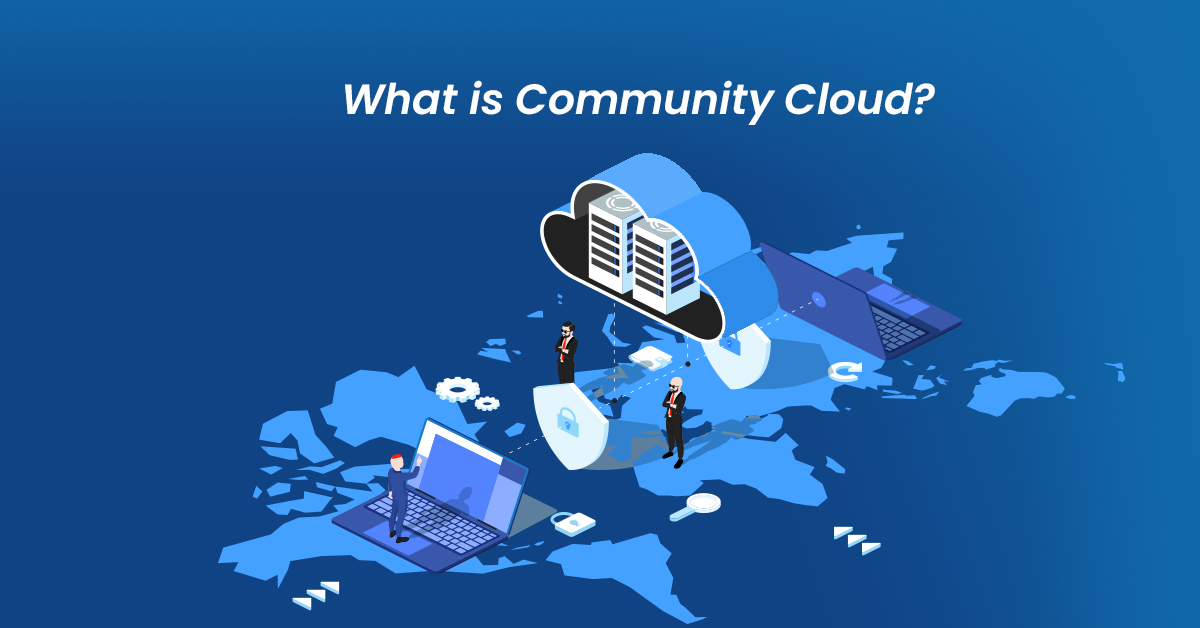
What is Community Cloud?

A community cloud is a single, sector-specific solution that combines the advantages and capabilities of various cloud types (Banks, insurance, government, enterprise, etc.). It is also best suited for organizations working on related applications, research topics, or projects that require the same resources. A community cloud is an example of a private cloud that provides specialized infrastructure for businesses from a particular community with shared concerns about security, compliance, jurisdiction, etc. When it comes to cost-effectiveness, privacy, and security, it is the perfect answer.

What is Community Cloud


1. Rising Demand for Community Cloud

Recently, we’ve seen many major Cloud Service Providers offering Community Cloud Services, whether Government Community Cloud, Banking Community Cloud, or Enterprise Community Cloud, each offering particular services for the prescribed business vertical. The key differentiators are each cloud vertical’s technical, security, and compliance tools. However, the true potential of these communities is yet to be achieved with the requirement of vertical cloud or community cloud services for emerging business verticals like IoT, Healthcare, e-Commerce, Insurance, Autonomous Vehicles, etc., as each one of these business verticals is going to have requirement of specialized tools with specific compliance configurations, security, and performance-based upon a uniform data model.

Read More>>

Tuesday, 16 August 2022

Digital Transformation in The Cooperative Sector

In India, the cooperative sector plays a crucial role in the banking ecosystem. There are 1,531 urban cooperative banks and 97,006 rural cooperative banks as of May 31, 2021. Moreover, the overall depositor base of these banks exceeds eight crores. With such a significant contribution, the complete digital transformation of these banks is essential to make them future-ready. Especially after the advent of the pandemic, the digital transformation of cooperative banks has become a must. Although technological advancements have already begun in the cooperative sector, it still has much to catch up with high-tech commercial banks.
digital transformation


Cooperatives must digitize if they want to navigate the shifting environment. They could be able to provide financial services through conventional means and physical locations. However, this may not be useful in retaining important clientele that prefers simple and digital operations in the future. 

At present, cooperatives rely on close relationships with their clients and members. Although trust and relationships with stakeholders are important, they may not be enough to attract the current generation to financial services.

Moving to Cloud & a Reliable DR plan: The foundation stone for total Digitization

Cloud computing is an essential tool for the cooperative sector in order to stay competitive in the face of growing private banks today. With the Cloud, banks can improve agility, drive innovation with cutting-edge technology, utilize industry-specific solutions, and shift their spending paradigm from CapEx to OpEx.

Cloud & a Reliable DR plan


ESDS has dedicated BFSI community cloud services that are a highly adaptable platform that supports Hosted Payment and Security Services, Core Banking Solutions (CBS), and cutting-edge technology. ESDS BFSI Community Cloud is built in strict compliance with regulatory requirements, security guidelines, and resilience guidelines mandated by the Reserve Bank of India (RBI). To date, 450 + Cooperative Banks, UCB, DCCB, and Apex banks are working with us as partners to transform their banks into digital transformation. 

Read More>>

Monday, 18 July 2022

How Can Managed Colocation Help Your Scaling Business?

For your growing business, you certainly need enough space to accommodate the ever-increasing IT infrastructure. Again, when it comes to growing infrastructure, it includes considerable space, cost, and an IT team to manage the IT infrastructure.
Managed Colocation ESDS

Your expanding business needs may not be cost-effective, but it certainly has solutions that would accommodate your scaling business requirements.

It is essential that your business infrastructure scales and performs at the right time when needed. Also, you need to know your long-term business needs and their impact on the overall business workflow.

There are several alternatives accessible for IT infrastructure. However, if you have a clear set of business objectives, are aware of the existing state of your organization’s IT infrastructure, and are ready to make a change to maximize deployment in the long run, managed colocation is just what you need. Nevertheless, what exactly is managed colocation, and why should it be preferred over on-premises or cloud-based solutions?

Colocation

Colocation is the provision in which a service provider offers space on its premises for an organization’s equipment and IT infrastructure.

It is an excellent alternative for companies that want to maintain control over their infrastructure but lack the physical room to house their equipment.

Read More>>

Wednesday, 22 June 2022

A Good Strategy – To Scale up your Business

Data has become an invaluable asset for businesses of any type and size or industry. To put this data to use and yield value for a business, requires developing a Data Strategy. Businesses across the globe invest heavily in gathering, analyzing, organizing data, and churning it for multiple uses, which can be quite challenging. Developing a Data Strategy assists organizations to utilize the data extensively without compromising on resources.

Data Strategy

Organized data gives clarity to making important decisions and other strategic actions for the business. Since Data has become a precious resource, security becomes the highest priority. As more and more businesses are shifting towards digital transformation, staying on par with business trends is essential while also protecting the business data from hacking and cyber-attacks is equally crucial.

To Implement a Data Strategy

Importance of Data Strategy – Why your business needs a (modernized) data strategy?

  • Un-organized and steady moving organizational processes
  • Un-structured and duplicated data with quality issues
  • Capability issue to analyze business workings to churn the data for the right use
  • Unable to identify the business’s growing needs and market trends
  • Lack of clarity in terms of segregating the data at hand
  • Work repetition and errors waste resource time

Factors to Consider

To implement a data strategy, an organization needs to have concrete plans and financial investments in place to follow through. The IT team and management personnel must be at the forefront of running the entire activity along with support from the entire organization.

Read More>>

Wednesday, 15 June 2022

Networking Defined By Software: Seven Ways to Implement Them


Networking Defined By Software

In few IT groups, Software Defined Networking (SDN) is still viewed as a hypothetical idea or vaporware to a great extent. Even though SDN  is valid multiple fields, the truth is that we now have few circumstances where SDN can be utilised – and you will be able to see several cases in the coming years. What was previously just another buzzword expressed by IT marketing experts, has now transformed into a practical idea which most of us can make use in organization networks.

Who can precisely derive the benefits from SDN deployments today? There are many factors playing an important role in answering this question. For one, a small portion of your network architecture must be fit for utilising software-defined technologies or can be redesigned to permit such centralised orchestration.

The widest areas where SDN can be applied today is either inside the datacenter or at the WAN control. While it’s feasible for SDN to loosen up completely to the access layer, few networks have suitable hardware in access closets. In any case, that shouldn’t prevent us from considering practical uses. What’s more is once your next network recharge comes around, you will be prepared to take benefits of SDN capacities that are arid.

Another element that influences the value and reasonability of SDN in an enterprise surrounding needs to do with the level of infrastructure virtualisation that has effectively occurred. Software-defined networks ought to be considered as the following stride in the ongoing advancement of desktop virtualisation and/or server. Several advantages of SDN particularly in the Datacenter feels that servers and other system administrations should be virtualised too. This permits network administrators to take advantage of all infrastructure assets to make an end-to-end and integrated solution that can be controlled centrally. Probably, in case you’re examining the realism of SDN, all this time you have been utilizing server virtualization to a considerable degree in your environment.

Read More>>

Wednesday, 8 June 2022

How to Utilize Cloud Security Measures for Scaling your Business Growth

 While most of the world and businesses have adopted the cloud to ensure ongoing business practices during the pandemic, data security has always been a concern. As a matter of fact, cybersecurity has been a major concern long before the pandemic. To improve and make day-to-day business operations more efficient there are thousands of cloud service providers available in the market. Without a doubt during the difficult times of the year 2020, cloud computing services have been saviors to corporates and startups along with all SMEs.

How to Utilize Cloud Security Measures for Scaling your Business Growth

The concern of data security begins right from an individual level to large multi-national and even global organizations. While the cloud has helped organizations run smoothly and churn income during the pandemic, the safety and security of the essential data have been taken into consideration by the cloud service providers. With cloud security that is designed to protect the data on the cloud along with other applications it also safeguards from threats and cyberattacks. With a combination of services, high-end technologies, and higher control, cloud security ensures the prevention of data loss. Cloud security measures also work on the lines of data privacy regulations and other organizational compliances. Let’s understand more about cloud security measures.

Read More>>

Sunday, 5 June 2022

VPN: A growing factor aiding businesses

The use of Virtual Private Network (VPN) usage has exploded exponentially in recent years and for good reasons. MarketWatch, in a recent press release for their “Virtual Private Network (VPN) Market 2020 Research Report”, states, “The market for VPNs has been growing at an increased pace since the COVID-19 pandemic, and it’s expected to surpass $92 billion in 2027.”
Virtual Private Network

With a combination of hardware and software capabilities, vast amounts of real-time data can now be encrypted and decrypted (relatively) quickly, as well as the ever-present and hazardous presence of the Internet for consumers and businesses, are among the factors responsible for this development. The globe today spends an increasing amount of time, connected to the Internet, increasing the risk of security breaches such as hacking into corporate databases, stealing your private, personal information, or listening in on live conversations and emails.

The use of virtual private networks (VPNs) for unblocking websites and protecting online privacy seems to have become a universal trend nowadays. But how do virtual private networks (VPNs) work and what are they for? Internet security has become synonymous with VPNs (virtual private networks). VPNs help you keep access to your passwords and sensitive information secure by routing your Internet traffic through a secure server. Apart from unblocking prohibited content, VPNs can also help you browse the internet anonymously and torrent in safety.

A VPN, on the other hand, is more than just connecting to a remote server. Continue reading to discover more about virtual private networks (VPNs), how they function, and what to look for when selecting a VPN service.

Read More>>

Wednesday, 1 June 2022

Data Center Services and Its Different Types

 Data Centers, for all intents and purposes, are structures that provide shared access to applications and data using a complex network, compute, and storage infrastructure.

Data Center Services and Its Different Types

From small server rooms to groupings of geographically distributed buildings, data centers come in all sizes and shapes, but one thing they all have in common is this: data centers are critical assets where companies often invest in and deploy the latest advances in data center networking, computing, and storage technologies.

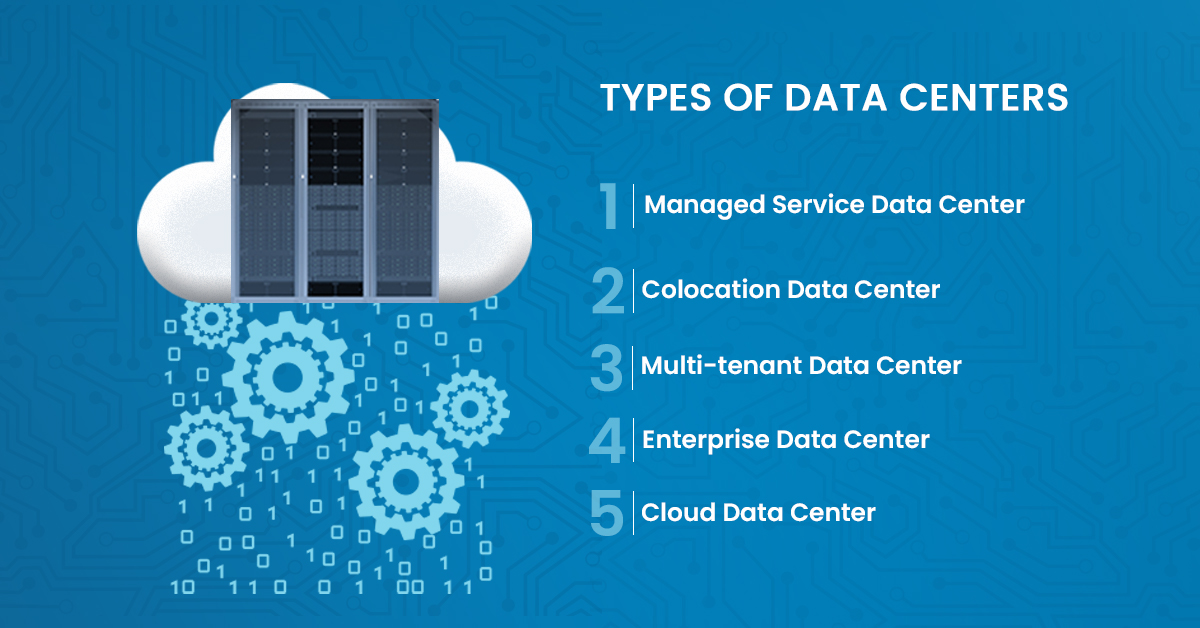
Types of Data Centers

Rather than being a space dedicated to on-premises infrastructure, today’s data centers contain on-premises systems in conjunction with cloud infrastructures that will make use of virtualized networks, applications, and workloads across multiple private and public clouds.

Types of Data Centers
  • Enterprise Data Centers are usually designed and maintained by a single organization for its own internal needs. Technology giants typically have them.
  • Colocation Data Centers are rentals of data center space and resources that are made available to people who wish to access them.
  • Managed Service Data centers take care of aspects such as data storage, computing, and other services directly for customers.
  • Cloud Data Centers provide customers with distributed and managed services provided by third parties.

 Read More>>

Tuesday, 24 May 2022

What is Community Cloud? Make the Most Out of ESDS Community Cloud!

A study about cloud computing infers that cloud computing may grow by more than $390 billion by 2028. With the growing cloud market, the community cloud market is expected to develop at a CAGR of 31.29% by 2026, reaching a market size of US$14.806 billion.
What is Community Cloud


Cloud computing has grown dramatically in the coming few years, especially since the outbreak of the covid-19 pandemic. Many businesses shifted to the cloud as automation and being online was the only way to sustain the industry. 

Cloud computing has boomed in various sectors like enterprise, government, healthcare, BFSI, etc.

With the variety of deployment models offered by the cloud, community cloud computing is preferred by many industries for the many benefits it delivers. The community cloud has transformed into a constantly evolving landscape for cloud deployment.

Let us dive into community cloud details!

What Is Community Cloud

A community cloud is a type of private cloud, which offers dedicated infrastructure for organizations from a specific community with common concerns like security, compliance, jurisdiction, etc. It is an ideal solution in terms of cost-effectiveness, privacy, and security.

A community cloud combines the features and benefits of different cloud types into a single solution customized to a specific industry (Banks, insurance, government, enterprise, etc.). It is also appropriate for organizations working on a similar project, research topic, or application and requires identical resources.

A community cloud is not open to the public; it is only accessible to a selected group of people. It is adaptable as it can be designed and managed by one or all members of an organization and a third-party provider.

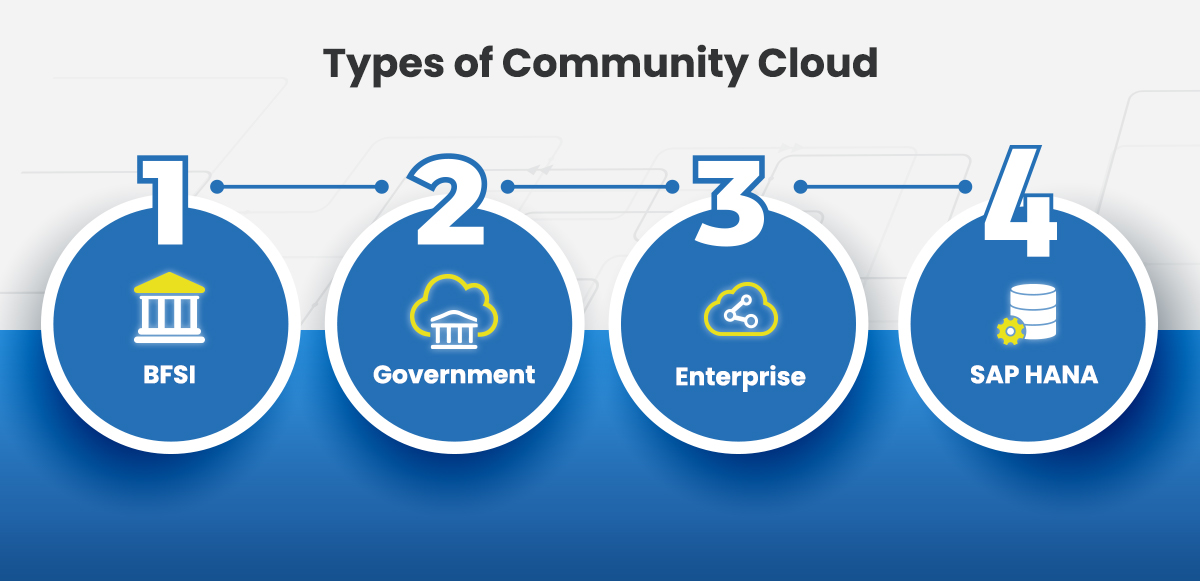
Types of Community Cloud

Types of Community Cloud

BFSI community cloud operates specifically for banking, insurance, and financial industries by streamlining the entire workflow of the organization.

Read More>>