Showing posts with label colocation data center. Show all posts

Monday, 5 January 2026

Colocation vs Building Your Own Data Center in India (2026)


As India’s digital infrastructure matures, enterprises are re-evaluating one of the most capital-intensive decisions in IT: whether to build and operate their own data center or adopt a colocation model.

By 2026, this decision is no longer driven purely by ownership or control. It is shaped by capital efficiency, regulatory compliance, scalability, time-to-market, and long-term return on investment (ROI). Rising land prices, power constraints, sustainability expectations, and AI-driven compute density have significantly altered the economics of data center ownership.

This article presents an India-specific comparison of colocation vs building an in-house data center, with a clear cost breakdown and ROI perspective to support informed enterprise hosting India decisions.

Understanding the Two Models

What Is Colocation?

Colocation allows enterprises to place their own IT hardware servers, storage, and networking equipment inside a third-party data center facility. The provider delivers:

  • Reliable power and backup systems
  • Cooling and environmental controls
  • Physical security and monitoring
  • Carrier-neutral connectivity
  • Compliance-ready infrastructure

The enterprise retains hardware ownership and architectural control, while the data center operator manages the facility.

What Does Building Your Own Data Center Involve?

Building a captive data center means end-to-end ownership and responsibility for:

  • Land acquisition or long-term leasing
  • Facility construction and civil works
  • Electrical, cooling, and fire-safety systems
  • Compliance certifications and audits
  • 24×7 operations and maintenance

While this model offers maximum control, it also concentrates capital risk and operational complexity within the enterprise.

Cost Breakdown: India Context

1. Land and Real Estate

Own Data Center

  • High land acquisition costs, especially in metro and Tier-1 regions
  • Zoning, environmental clearances, and approval timelines
  • Capital locked in non-productive assets

Colocation

  • No land ownership required
  • Real estate costs embedded into predictable colocation pricing

ROI impact:
Land acquisition significantly delays ROI realization in owned data centers, whereas colocation enables faster deployment without long-term real estate exposure.

2. Construction and Core Facility Infrastructure

Own Data Center Major upfront investments include:

  • Building shell, raised floors, and structural reinforcements
  • Electrical substations, transformers, DG sets, and UPS systems
  • Cooling plants, chillers, CRAH/CRAC units, and containment
  • Fire detection and suppression systems

These are high-CAPEX, long-depreciation assets.

Colocation

  • Infrastructure is already built and maintained
  • Enterprises pay only for the space, power, and redundancy consumed

ROI impact:
Colocation converts heavy capital expenditure into operationally aligned spending, improving capital efficiency.

3. Power, Cooling, and Energy Efficiency

Own Data Center

  • Direct responsibility for power procurement and redundancy
  • Fuel logistics and generator maintenance
  • Efficiency depends heavily on internal design and expertise

Colocation

  • Optimized power density and cooling efficiency at scale
  • Shared redundancy models
  • Better alignment with evolving efficiency and sustainability practices

ROI impact:
Power and cooling are among the largest long-term cost drivers. Colocation generally delivers more efficient cost-per-kW economics over time.

This becomes especially relevant as AI and high-density workloads reshape infrastructure requirements.

4. Compliance, Security, and Governance

Own Data Center

  • Continuous investment in compliance certifications and audits
  • Dedicated teams for governance, documentation, and upgrades
  • Higher operational risk if standards evolve

Colocation

  • Facilities are designed to support multiple regulatory and audit requirements
  • Faster audit readiness
  • Reduced compliance management overhead

ROI impact:
Compliance is a recurring cost. Colocation reduces compliance-related friction and improves colocation ROI 2026 projections.

5. Staffing and Operations

Own Data Center Requires:

  • 24×7 facility operations teams.
  • Electrical, mechanical, and safety specialists.
  • Vendor, spare-parts, and lifecycle management.

Colocation

  • Facility operations handled by the provider.
  • Enterprise teams focus on IT workloads, not physical infrastructure.

ROI impact:
Operational staffing costs compound annually. Colocation lowers non-core operational overhead, improving long-term ROI.

ROI Analysis: When Each Model Makes Sense

Building Your Own Data Center May Be Viable When:

  • Workloads are extremely large and stable
  • Utilization remains consistently high over 10–15 years
  • Low-cost land and power are available
  • Strong in-house data center engineering capability exists

ROI improves only after several years of sustained utilization.

Colocation Delivers Stronger ROI When:

  • Workloads grow or change over time
  • Capital preservation is a priority
  • Compliance and audit readiness are critical
  • Faster deployment directly impacts business outcomes

For many enterprises, colocation reaches positive ROI earlier due to reduced upfront investment and faster production readiness.

Where ESDS Colocation Fits in Enterprise Infrastructure Planning

Within the colocation India landscape, ESDS Software Solution Limited provides colocation data center services designed for enterprises seeking infrastructure control with operational efficiency.

ESDS colocation facilities are structured to support enterprise workloads that require:

  • India-based data residency
  • High availability infrastructure
  • Predictable operating economics
  • Alignment with regulatory and audit requirements

From a data center cost comparison perspective, ESDS colocation enables enterprises to avoid the capital intensity of building facilities while maintaining ownership of IT assets. The model supports incremental scaling of space and power, allowing infrastructure investment to align with business growth rather than long-term fixed commitments.

Colocation also integrates effectively with hybrid and cloud-based architectures, acting as a stable physical foundation alongside cloud services.

For enterprises evaluating alternative hosting models such as private cloud as part of a broader strategy.

Final Perspective: Colocation vs Own Data Center in 2026

In 2026, building a captive data center is a high-commitment, long-horizon investment suitable only for organizations with very specific scale and maturity profiles.

For most enterprises, colocation offers:

  • Faster ROI realization
  • Lower financial and operational risk
  • Improved capital efficiency
  • Better alignment with hybrid and AI-driven infrastructure strategies

When evaluated through a colocation ROI 2026 lens, colocation increasingly emerges as a rational, flexible alternative to owning and operating a private data center.

For more information, contact Team ESDS through:

Visit us: https://www.esds.co.in/blog/data-center-services/

🖂 Email: getintouch@esds.co.in; ✆ Toll-Free: 1800-209-3006

Monday, 17 March 2025

Common Myths About Colocation Services


When it comes to IT infrastructure, businesses often find themselves at a crossroads: should they continue investing in on-premise setups, migrate to the cloud, or explore colocation services? While colocation hosting has been a trusted choice for enterprises looking for security, scalability, and cost optimization, several misconceptions still surround it. These myths often prevent organizations from making informed decisions, leading to inefficient IT strategies. 

It’s time to separate fact from fiction. Let’s debunk some of the most common myths about colocation services and help businesses understand how modern colocation solutions can transform their IT operations. 

Myth 1: Colocation is Just a Fancy Term for Traditional Data Centers 

Reality: Colocation is far more than just renting rack space. 

A traditional data center provides the physical infrastructure for storing IT equipment, but colocation services go beyond that. Colocation providers offer advanced cooling systems, high-speed network connectivity, 24/7 monitoring, and even AI-driven optimizations for resource allocation. Unlike traditional setups, modern colocation hosting services integrate automation, intelligent load balancing, and real-time monitoring to enhance operational efficiency. 

Myth 2: Colocation is More Expensive Than Cloud Hosting 

Reality: When done right, colocation is a cost-effective alternative to both cloud and on-premise setups. 

A common assumption is that colocation solutions require hefty upfront investments. However, what many fail to consider are the hidden costs of cloud services—such as unpredictable pricing models, egress fees, and performance bottlenecks. In contrast, colocation hosting allows businesses to retain control over their hardware while benefiting from enterprise-grade infrastructure at a fraction of the cost of building and maintaining an in-house data center. 

Myth 3: Colocation Lacks Scalability and Flexibility 

Reality: Colocation services are built for dynamic scaling. 

The misconception that colocation is rigid stems from outdated perceptions of IT infrastructure. Modern colocation providers offer on-demand scaling, allowing businesses to expand or contract their server footprint as needed. With AI-driven resource allocation and hybrid cloud connectivity, colocation solutions today offer the same flexibility that enterprises expect from cloud environments. 

Myth 4: Managing Colocation Infrastructure is a Headache 

Reality: With the right provider, colocation management is seamless and efficient. 

Concerns about managing hardware in a remote colocation data center often deter businesses from exploring colocation hosting services. However, most colocation service providers offer remote hands support, real-time monitoring dashboards, and automated maintenance solutions. AI-driven predictive analytics even enable proactive troubleshooting, reducing the need for constant manual intervention. 

Myth 5: Colocation is Only for Large Enterprises 

Reality: SMBs can benefit just as much from colocation hosting. 

Small and medium-sized businesses (SMBs) are increasingly using colocation hosting in India and around the world, despite large enterprises historically being the main colocation adopters. SMBs can access Tier III and Tier IV data center facilities through colocation without having to pay for their own construction and upkeep. Colocation offers a cost-effective, scalable substitute for mid-sized businesses in need of disaster recovery plans or startups seeking secure hosting.

Myth 6: Security is a Concern in Colocation Environments 

Reality: Colocation data centers are more secure than most on-premise IT setups. 

Security is often cited as a primary concern when considering colocation hosting. However, leading colocation providers implement multi-layered security measures, including: 

- AI-powered intrusion detection and anomaly monitoring 

- Biometric access controls and 24/7 surveillance 

- DDoS protection and advanced firewalls 

- Redundant power and failover systems to ensure uptime 

In fact, many businesses find that colocation offers better security than their on-premise data centers, where security investments are often limited. 

Myth 7: Colocation and Cloud Can’t Work Together 

Reality: Hybrid colocation is the future of IT infrastructure. 

It's a common misperception that companies have to decide between cloud hosting and colocation. In practice, the two complement each other well. With hybrid colocation solutions, businesses may use cloud environments for agility while hosting mission-critical workloads on dedicated servers. 

Dispelling the Myths: Why Colocation Makes Sense Today 

Businesses require infrastructure solutions that are scalable, secure, and economical as the landscape of digital transformation changes. Colocation now offers AI-powered efficiency, smooth scalability, and hybrid cloud compatibility in addition to physical server hosting. IT leaders are finding that colocation is a wise investment as businesses seek more control and dependability.

How ESDS is Redefining Colocation Services 

Intelligent colocation solutions are becoming more and more in demand as businesses reconsider their IT strategies. With its high-performance colocation hosting services and cutting-edge AI-driven automation, security, and energy-efficient infrastructure, ESDS is leading this change. By emphasizing scalability, sustainability, and seamless hybrid cloud integration, ESDS empowers companies to confidently adopt next-generation colocation solutions and dispel antiquated infrastructure fallacies. 

The myths are fading. The future of colocation is here.

Visit us: https://www.esds.co.in/colocation-services

For more information, contact Team ESDS through:

🖂 Email: getintouch@esds.co.in; ✆ Toll-Free: 1800-209-3006; Website: https://www.esds.co.in/

Friday, 20 September 2024

Best Colocation Data Center: A Comprehensive Guide for Businesses in India


Colocation Data Centers: An Introduction

As businesses further expand their digital infrastructure, the need for reliable, secure, and cost-effective data hosting solutions has become much more important than ever before. One choice for becoming a vital partner for businesses is the data center option for colocation.

A colocation data center facility provides organizations with space to lease servers and IT equipment. The provider manages the facility, including power, cooling, physical security, and networking. The service seeks to give organizations control over the hardware while leveraging expertise and resources from a colocation services provider.

What Makes ESDS Colocation Data Centers Stand Out?

Amongst companies looking for top-tier infrastructure and managed services, the preference goes to ESDS Colocation Data Centers. With enriched experience in this industry, ESDS offers end-to-end Colocation Services that involve higher security features, redundant power, cooling systems, and 24x7 monitoring. ESDS also provides managed colocation services by giving businesses technical support, remote monitoring, and maintenance for smooth operations with minimum downtime.

Choosing the Right Colocation Data Center Provider: Benefits There are quite several reasons why it is essential to choose the right colocation data center provider so that your company's IT operations run without hitches. Here are some key benefits of consideration:

1. Cost Efficiency: The renting of space in colocation data centers saves companies from the very high upfront costs associated with building and maintaining facilities for their data centers. The pricing models are tiered, which allows businesses to scale.

2. Increased Security: Colocation services providers implement multiple innovative physical and cybersecurity mechanisms. These would include biometric access controls, surveillance, fire suppression systems, and data encryption technologies to safeguard your equipment and data from threats.

3. Scalability: Be it a start-up or an enterprise, colocation service providers in India can offer flexible solutions that will meet the needs of growth accompanying your business. This would mean that you can easily scale your IT infrastructure up or down without a bother to manage your facilities.

4. Redundancy for Reliability: The best colocation data centers will have redundant sources of power, cooling, and internet connectivity. These assure high uptime and negate the possibility of business downtown.

5. Access to Expertise: Outsourcing using managed colocation services offers access to highly qualified IT professionals who can extend support for server management, performance optimization, and troubleshooting to the companies. This lets companies stay focused on their core business and leaves the technical areas to the experts.

Why Colocation Services Are the Future

Colocation services are prime in this age, where data is paramount to business enterprise success. Colocation services provide a cost-effective and scalable solution. While looking for ways of managing increasing demands for IT services, colocation data center providers become a tempting alternative aside from building one's in-house facility. A rightly chosen data center will increase IT performance, security, and flexibility while reducing operational overheads.

Conclusion

The demand for reliable colocation services is growing rapidly in India, driven by providers such as ESDS that offer top-notch infrastructure, security, and managed services. A company seeking to make its IT operations secure but scalable for the future will do best by partnering with a trusted colocation service provider. Whether seeking managed colocation services or simply looking for a place securely to house their servers, choosing the right provider will mean everything to your organization's success.

Visit us: https://www.esds.co.in/colocation

For more information, contact Team ESDS through -

🖂Email: getintouch@esds.co.in| ✆Toll-Free: 18002093006 | Website: https://www.esds.co.in/

Sunday, 11 August 2024

Taking IT Control to the Next Level: The Power of Colocation

Let’s explore the concept of Colocation Hosting through an example. Imagine you own a car and need a safe place to keep it. You could build a garage in your house, but it would be costly and would entail regular upkeep for the space set aside for it. Instead, you opt for renting a nearby secure parking spot.


In the same way, colocation hosting involves looking for storage spaces to accommodate servers, applications, and hardware. The data center or colocation facility is actually where you would relocate your server, application, and other such equipment physically. This means that users have total ownership as well as authority over their servers and even all their parts. Additionally, one can monitor and control the servers at all times of day or night. Usually, customers using colocation hosting are companies like financial institutions or tech firms that need high levels of security for their hardware to be utilized it effectively.

My observation is that colocation hosting is little discussed in comparison with some other forms of web hosting including shared web hosting. Its major shortcoming compared to these other options is the higher cost it comes with.

We will look into how colocation differs from traditional web-hosting models.

What Is the Difference between Web Hosting and Colocation Hosting?

The main difference between a web hosting solution and colocation is the degree of control you have. Colocation facilities give you the benefits of data centers, such as 99.995% uptime, reliable speed and connectivity, risk management, dedicated IPs, and modern infrastructure. But one doesn’t have full access to your IT equipment, unlike other managed solutions

Web hosting is usually shared and uses a cloud-based, virtual private server, which doesn’t give you the same level of control or security. Moreover, shared web hosting is less expensive, giving benefits to individuals and small businesses.

Whereas, colocation is a service offered only by data centers where companies can opt to have their IT hardware, such as their servers, stored and optimized.

When Do You Need Colocation Services?

You’ll need colocation services when you run into a problem where the space, and environment limit the hardware, and power supply they can currently provide.

Many businesses may cut capital expenditures by not opting to build their own data center, which can be very expensive to develop and maintain, and instead may turn to colocation facilities.

However, if you are a smaller business enterprise, it is better to opt for Shared web hosting rather than colocation which can increase your capital costs compared to other options.

Do you need a Colocation Hosting Provider?


A collocation hosting provider would be useful for:

Small Businesses

A small business doesn’t need colocation hosting, when there is a cost constraint. Still, the benefits of colocation can be great for other businesses, such as a business looking to increase its security and bandwidth.

Large Businesses

A large business may benefit most from a colocation data center because of its 24/7/365 availability, Speed, and third-party maintenance.

Who Doesn’t Need Colocation Services?

If your business needs frequent access to your servers, you may benefit from keeping your servers in the same space and developing your on-site colocation facility. The increased travel costs to send your engineers to the colocation facility may make colocation service a less desirable choice for you.

Additionally, colocation hosting can be costly. While less expensive than building your own data center, colocation hosting is typically quite expensive and won’t suit many companies just starting or a customer with a smaller business. Shared hosting may be a better alternative if cost is a concern.

In addition, if you need hands-on service to have your servers configured and maintained regularly, colocation services may not be your best choice. Colocation hosting does not typically offer these management features, so your software and hardware are still your responsibility.

Managed services always come with increased costs.

The Advantages of Colocation Hosting


As per your needs, companies can use hosting services that fit the budget. Colocation hosting is widely used by businesses that wish to increase their IT resources but avoid the high expenses associated with hiring a Managed Service from a colocation hosting provider’s place and having your server linked to the provider’s network.

•        Faster Response Time – To deliver superior service, it is essential to have a faster server response

·         IP Address – A unique IP address is given to each customer to gain internet connectivity from the colocation facility.

•        Cooling System – The temperature control systems used by data center administrators are made available by colocation hosting services. Keeping servers at the optimal temperature and humidity may be difficult which is crucial for optimal functioning and performance.

•        Unlimited Power Supply – No guarantee is given by the Hosting provider which can reduce potential threats by moving your server out of your workplace and into a facility designed to minimize power use.

•        Cost Optimization – One has to only pay a fee for the data center as a monthly rent cutting down on transportation costs.

•        On-site Monitoring – Data centers employ support personnel to monitor things around the clock, every day of the year.

•        Control – You can rest assured that your company will maintain complete management of its data while using a colocation hosting service. You’re the one in charge of server upkeep and settings. In addition, you can leverage the data center's facilities.

Making the Colocation Hosting Decision with ESDS

Your bottom line might drive the decision to move to colocation hosting. By making the switch, you can redirect your focus back to revenue-generating projects and away from managing your data center. However, it's natural to have questions before committing.

The colocation experts at ESDS are here to provide all the answers you need, with a strong emphasis on customer satisfaction.

Visit us: https://www.esds.co.in/colocation

For more information, contact Team ESDS through -

🖂 Email: getintouch@esds.co.in | ✆ Toll-Free: 1800 209 3006 | Website: https://www.esds.co.in/

Wednesday, 1 June 2022

Data Center Services and Its Different Types

 Data Centers, for all intents and purposes, are structures that provide shared access to applications and data using a complex network, compute, and storage infrastructure.

Data Center Services and Its Different Types

From small server rooms to groupings of geographically distributed buildings, data centers come in all sizes and shapes, but one thing they all have in common is this: data centers are critical assets where companies often invest in and deploy the latest advances in data center networking, computing, and storage technologies.

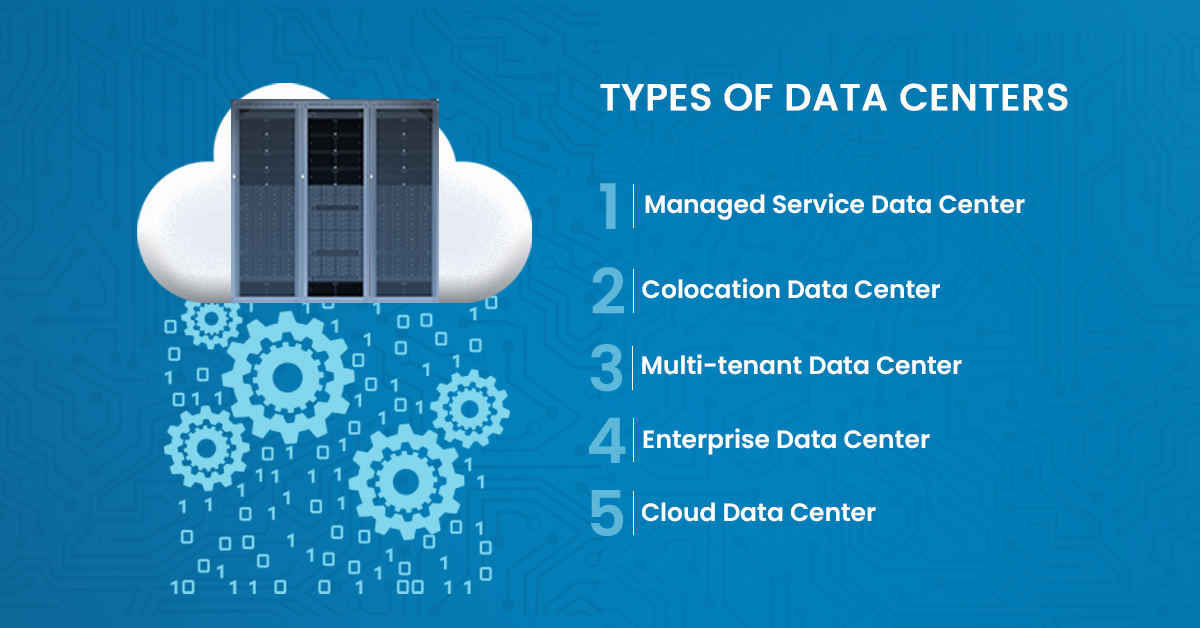
Types of Data Centers

Rather than being a space dedicated to on-premises infrastructure, today’s data centers contain on-premises systems in conjunction with cloud infrastructures that will make use of virtualized networks, applications, and workloads across multiple private and public clouds.

Types of Data Centers
  • Enterprise Data Centers are usually designed and maintained by a single organization for its own internal needs. Technology giants typically have them.
  • Colocation Data Centers are rentals of data center space and resources that are made available to people who wish to access them.
  • Managed Service Data centers take care of aspects such as data storage, computing, and other services directly for customers.
  • Cloud Data Centers provide customers with distributed and managed services provided by third parties.

 Read More>>