Showing posts with label cloud service providers. Show all posts

Thursday, 8 December 2022

Cloud Computing and Solutions in the Age of 5G

Experts in telecommunications have finally gotten to the fifth generation of mobile connectivity, or 5G. The 4G network, which was devised in the 2000s, optimized the speeds at which our mobile devices operated on. With this technology on board, we could record and view high-definition videos, browse the internet at fast speeds, and even make high-definition video calls. But now that we have a 5G network, things will get more engaging, and cloud computing is particularly relevant.

cloud computing with 5G

In just a few years, it has transformed from a technology that was barely discussed to one that is poised to change the face of connectivity — and not just for smartphones. Cloud computing is fundamental for a healthy business infrastructure, and 5G is pivotal for empowering them to intake data in real-time. 5G will unleash tremendous computational power.

Consider operating a business virtually; in this case you need high-speed data storage and transfer. Low latency, greater capacity, and faster network speeds of 5G will be a catalyst for cloud computing. Next-generation networks will accelerate cloud adoption for businesses.

How Is Cloud Computing Influenced By 5G Technology?

5G and cloud computing are shaping the future of business. This technology will have a massive impact on your cloud computing operations. As desktop computers are being replaced by mobile devices, we will rely on the cloud for greater speeds & efficiency. To achieve this, 5G technology is essential for a higher level of data transmission.

how does 5G Transformation cloud computing

Previously, cloud computing was hindered by limitations with augmented reality. It usually had to process information in a centralized location, which made it vulnerable to hacking. This will no longer be a problem because it can process information anywhere and still be able to interact with an augmented world.

For instance, the improved speed and service dependability of 5G will benefit unified communications services used by businesses. Everyday mobile apps are also cloud-dependent and will improve as 5G’s low latency capabilities become available. This entails faster, smoother transfers and improvements over current 4G connectivity.

Read More>>

Wednesday, 15 June 2022

Networking Defined By Software: Seven Ways to Implement Them


Networking Defined By Software

In few IT groups, Software Defined Networking (SDN) is still viewed as a hypothetical idea or vaporware to a great extent. Even though SDN  is valid multiple fields, the truth is that we now have few circumstances where SDN can be utilised – and you will be able to see several cases in the coming years. What was previously just another buzzword expressed by IT marketing experts, has now transformed into a practical idea which most of us can make use in organization networks.

Who can precisely derive the benefits from SDN deployments today? There are many factors playing an important role in answering this question. For one, a small portion of your network architecture must be fit for utilising software-defined technologies or can be redesigned to permit such centralised orchestration.

The widest areas where SDN can be applied today is either inside the datacenter or at the WAN control. While it’s feasible for SDN to loosen up completely to the access layer, few networks have suitable hardware in access closets. In any case, that shouldn’t prevent us from considering practical uses. What’s more is once your next network recharge comes around, you will be prepared to take benefits of SDN capacities that are arid.

Another element that influences the value and reasonability of SDN in an enterprise surrounding needs to do with the level of infrastructure virtualisation that has effectively occurred. Software-defined networks ought to be considered as the following stride in the ongoing advancement of desktop virtualisation and/or server. Several advantages of SDN particularly in the Datacenter feels that servers and other system administrations should be virtualised too. This permits network administrators to take advantage of all infrastructure assets to make an end-to-end and integrated solution that can be controlled centrally. Probably, in case you’re examining the realism of SDN, all this time you have been utilizing server virtualization to a considerable degree in your environment.

Read More>>

Monday, 14 March 2022

13 Benefits of Cloud Computing for Your Business


Cloud computing has been one of the most revolutionary trends in the tech world. Being a key player in the digital transformation of all the business verticals, it has earned widespread use over the last few years. According to Gartner’s report, the global spending on cloud services is predicted to surpass $482 billion in 2022, up from $313 billion in 2020 due to the many benefits of cloud computing for businesses.
Benefits of Cloud Computing for Your Business

With data dominating business success in the 21st century, it has become challenging for organizations to store, maintain, and secure their critical information and systems up and running on an in-house IT infrastructure. The solution to all this is migrating to Cloud computing. Cloud computing is a method of delivering a computing environment encompassing servers, storage space, databases, networking, software over the internet.

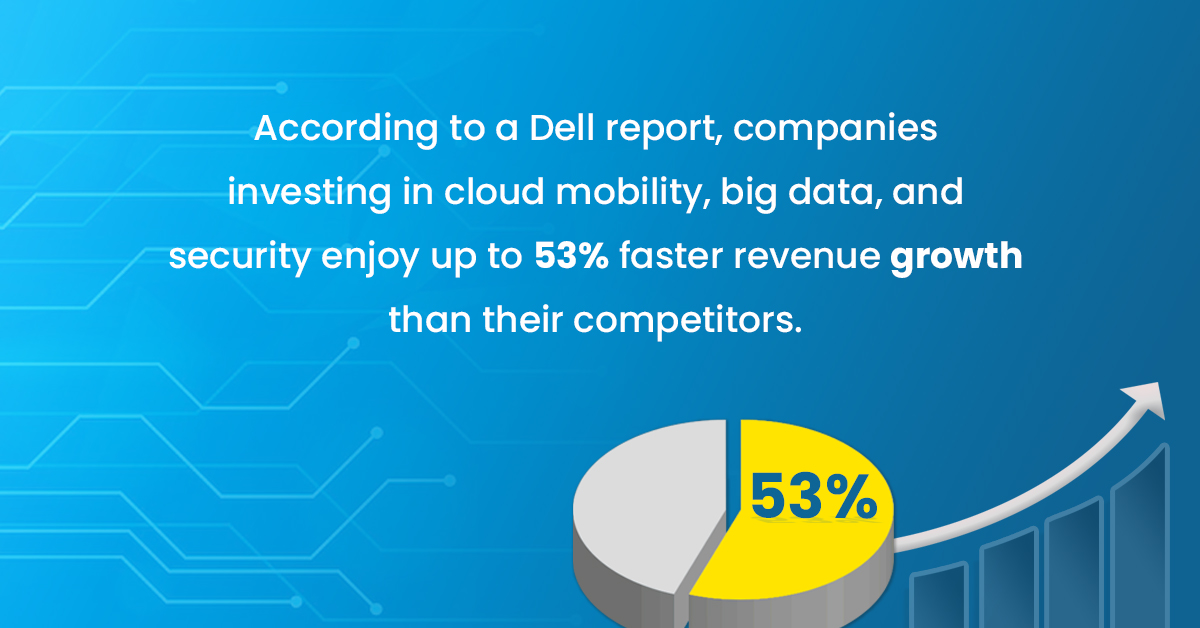
Though tech giant Dell’s study says companies that have invested in big data, cloud, mobility, and security have experienced 53% faster revenue growth than their competitors, many organizations are still unsure about migrating to cloud-computing solutions for their organizations. So, we’d want you to read these key benefits of cloud computing for businesses.

Benefits of Cloud Computing for Your Business 1

13 Benefits of Cloud Computing for Businesses

1. Cost Savings

Cloud computing is likely the most cost-efficient method to use, maintain, and upgrade your IT infrastructure. Additionally, the subscription-based model of cloud computing cut down on capital expenditure.

According to Multisoft, mid-size businesses find that using third-party cloud platforms resulted proved to be 40% more cost-effective than maintaining an in-house system.

Read More>>

Wednesday, 24 November 2021

Networking Defined By Software: Seven Ways to Implement Them

 Networking Defined By Software


In few IT groups, Software Defined Networking (SDN) is still viewed as a hypothetical idea or vaporware to a great extent. Even though SDN  is valid multiple fields, the truth is that we now have few circumstances where SDN can be utilised – and you will be able to see several cases in the coming years. What was previously just another buzzword expressed by IT marketing experts, has now transformed into a practical idea which most of us can make use in organization networks.

Who can precisely derive the benefits from SDN deployments today? There are many factors playing an important role in answering this question. For one, a small portion of your network architecture must be fit for utilising software-defined technologies or can be redesigned to permit such centralised orchestration.

The widest areas where SDN can be applied today is either inside the datacenter or at the WAN control. While it’s feasible for SDN to loosen up completely to the access layer, few networks have suitable hardware in access closets. In any case, that shouldn’t prevent us from considering practical uses. What’s more is once your next network recharge comes around, you will be prepared to take benefits of SDN capacities that are arid.

Read More>>

Monday, 21 June 2021

Cloud Compliances – The Modern-Day Success Mantra

After going through the topic, one might wonder how Cloud-based compliances have a role to play in the success of an organization. Read the upcoming section to understand why Cloud compliances are considered the modern-day success mantra for any organization.
Cloud Compliances

Ensuring Cloud compliances has been a significant challenge for many organizations. The inevitable demand for Cloud compliances rises as soon as a user migrates his critical data and applications to cloud hosting. Earlier, the Cloud Service Providers or CSPs didn’t throw weight on the data security or whether they aligned to industry compliances and regulations. Their main focus centered around offering data storage in the Cloud to the end-users. With the increasing demand for strict data laws across nations, Cloud Service Providers are now offering their Cloud hosting services in line with the latest industry compliances.

Determining Success with Cloud Compliances

1. Well-Defined Understanding of Regulations and Guidelines

A critical aspect of Cloud Computing involves various industry standards and regulations that everyone must adhere to. These regulations can be local, national, or even globally accepted ones. The local and national compliances may be true for a particular nation or group of nations, but the global ones need to be mandatorily followed. With advancements in technologies, CSPs are dealing with Cloud Compliances through expert teams. Such dedicated compliance teams ensure all compliance requirements of a business are met.

From the user’s perspective, he must be well aware of compliance policies and procedures. User’s CSP needs to be consistently compliant with the latest standards and must have all the supporting documents for these compliances and standards.

2. Restricting Access Controls

The absence of improper authentication and privileged access often become the primary source of data breaches taking place within an organization. MFA or Multi-Factor Authentication strategies are often apprehended as complicated and time-consuming. Advanced security mechanisms like MFA can be highly beneficial in avoiding all major security threats. Single Sign-On or SSO is a convenient option to consider but can also elevate hacking chances if the user credentials are compromised or hacked.

Read More>>

Wednesday, 14 November 2018

10 Reasons on Why Cloud Computing Makes Your Employees Efficient


Migrating to the cloud is a huge decision and therefore you need to weigh several pros and cons of before making any sort of changes in your infrastructure and the way of working. The ultimate goal of doing any new change in an organization is increasing ROI (Return On Investment); which also directly proportional to increasing the effectiveness and productivity of the employees. 


As per the surveys were done in the last decade, the organizations have voted in the favor of adopting cloud computing and said that they are benefited from this change. Employee productivity has increased in multiple ways like reducing downtime, increasing communication efficiency and collaboration.

Here are 10 reasons on why cloud computing makes your employees efficient –

· Reduction in Downtime

Seeing a downtime is a nightmare for the organizations and everyone wants an efficient service so that they hardly ever see this nightmare. Cloud service providers dedicate a special team to look after the smooth running of services for their clients. The technical support team ensures that the issues are responded at a faster rate. These steps help in reduction of the downtime and hence contributes in increasing employee productivity.

· Optimum Usage of In-House Resources

To enhance the efficiency of the company for an increased time, the cloud computing team makes sure that the team doesn’t get stressed due to the day-to-day tasks. Instead, the service provider sees to it that the team focuses on the new strategies and customer-specific problems. So, the organization utilizes the IT resources more efficiently and divides the tasks according to the team’s expertise.

· Enhancement in the Collaboration

The most known benefit of cloud computing is the ease of access. Employees are having the ease of accessibility by which they can fetch whatever they want from the cloud at anytime and anywhere. The feature of reaching out to the colleagues in real-time irrespective of location and time has given employees a liberty of work. Due to an increase in effective collaboration, companies have reported that productivity is increased by 400%! So, that is quite a big number!

· Adaption with the Market

The clients after shifting to the cloud, get the ability to use the latest tools and features. The feature of scalability, especially the vertical auto-scaling feature caused a big revolution in the cloud industry. This rise in flexibility gives organizations the power to serve to the heavy load requirements of clients on demand. Having the right and time-saving tools can make the employees more productive. 

· Integration with Current Systems

Generally, the major amount of cloud computing platforms easily integrates into different software applications. This seamless integration offers various benefits to the employees like switching between the tools instead of the manual passing of the information. Automatic switching between the tools consumes less time and is very likely to be error-free.

· Disaster Recovery and Prevention

There are situations where some sort of disaster can occur and wreak havoc on your organization. It may be due to online threats, malware or, ransomware attacks. The disaster recovery services provided by the cloud service providers can help you in dealing with such crisis situations. Due to virtualization, it is now possible to have multiple clones of your data easily available at the data centers.

· Increase in the use of own devices

Any internet-connected device has the potential to turn into a work machine depending on the load that device can take and the functions which need to be operated. Employees can now become more responsive on-the-go and hence this increases the productivity.

· Increased Competitiveness

After the research, many business owners say that they have gained a competitive position in the business race. Implementing cloud computing made them unable to capitalize the opportunities rapidly than other competitors. The technology gives organizations the power of speed and agility. Due to this power, the SMBs can easily come in the competition with bigger companies.

· Security Services Virtualized Too

With an increasing number of security breaches, ransomware attacks, and online frauds, there is even more necessity of a top-notch security service. Such attacks restrict the employees from getting access to data files, and the downtime can affect the productivity. Reputed cloud service providers have specialized security services which can prevent such threats, and even if they happen, they can make you recover quickly. Thus, this security-as-a-service also increases the productivity of your organization.

· Efficient Handling of Huge Chunks of Data

Due to cloud computing, handling the enormously increasing data is getting very smooth. Employees can sort, analyze, structure, design, and organize big data in a matter of minutes. Moreover, the data, statistics, and analytics can be easily shared and accessed across the organization, or even several branches of the organization swiftly in real-time. This makes decision-making super easy due to reducing the errors and repetitive efforts on the same tasks which lead to wastage of time.


All in all, cloud computing provides lots of ways which helps in increasing the productivity and efficiency of your organization and obviously in turn, of the employees.

About US:

For more information about importance of Cloud Computing, visit us at: Cloud Computing Providers AND Cloud Computing Platform

Monday, 2 October 2017

What is Cloud Computing?


To be precise, cloud computing is the delivery of computing services like servers, storages and more over the Internet. The companies that offer these computing services are called cloud providers. They charge for cloud computing services based on usage.

 Cloud computing is usually classified on the basis of location, or on the service that the cloud is offering.

Based on a cloud location, we can classify cloud as:

·         Public,
·         Private,
·         Hybrid
·         Community Cloud


Based on a service that the cloud is offering, we classify as:

·         IaaS (Infrastructure-as-a-Service)
·         PaaS (Platform-as-a-Service)
·         SaaS (Software-as-a-Service)
·         or, Storage, Database, Information, Process, Application, Integration, Security, Management, Testing-as-a-service


Cloud Types: Private, Public and Hybrid, Community

Depending on the type of data you're working with, you'll want to compare public, private, and hybrid clouds in terms of the different levels of security and management required.

·         Public Cloud – Whole computing infrastructure is located on the premises of a cloud computing company that offers the cloud service.

·         Private Cloud – Hosting all your computing infrastructure yourself and is not shared. The security and control level is highest while using a private network. 

·         Hybrid Cloud – using both private and public clouds, depending on their purpose. You host your most important applications on your own servers to keep them more secure and secondary applications elsewhere.

·         Community Cloud – A community cloud is shared between organizations with a common goal or that fit into a specific community (professional community, geographic community, etc.).

Types of cloud services: IaaS, PaaS, SaaS, FaaS

Cloud computing services fall into 4 categories: infrastructure as a service (IaaS), platform as a service (PaaS), software as a service (SaaS) and FaaS (functions as a service). These are sometimes called the cloud computing stack, because they build on top of one another.

1.      Infrastructure-as-a-service (IaaS)

IaaS is the most basic category of cloud computing services that allows you rent IT infrastructure (servers or VM’s) from a cloud provider on a pay-as-you-go basis.


2.      Platform as a service (PaaS)

Platform-as-a-service (PaaS) refers to the supply an on-demand environment for developing, testing, delivering and managing software applications. It is designed to quickly create web or mobile apps, without worrying about setting up or managing the underlying infrastructure of servers, storage, network and databases needed for development.


3.      Software as a service (SaaS)

Software-as-a-service (SaaS) is a method for delivering software applications over the Internet as per the demand and on a subscription basis. SaaS helps you host and manage the software application and underlying infrastructure and handle any maintenance (software upgrades and security patching).


4.      FaaS (functions as a service)

FaaS adds another layer of abstraction to PaaS, so that developers are completely insulated from everything in the stack below their code. Instead of handling the hassles of virtual servers, containers, and application runtimes, they upload narrowly functional blocks of code, and set them to be triggered by a certain event. FaaS applications consume no IaaS resources until an event occurs, reducing pay-per-use fees.

Uses of cloud computing

Although you do not realize you are probably using cloud computing right now, most of us use an online service to send email, edit documents, watch movies, etc. It is likely that cloud computing is making it all possible behind the scenes. Today a variety of organisations ranging from tiny startups to government agencies are embracing this technology for the following:

·         Create new apps and services as well as store, back up and recover data
·         Host websites and blogs
·         Stream audio and video
·         Deliver on demand software services
·         Analyze data for patterns
·         Make predictions


About US:

For more information about cloud service providers and data center services visit us at: cloud computing providers in India AND data center services