Showing posts with label Cyber Security. Show all posts

Friday, 15 November 2024

Cyber Security in Banking: Threats and Essential Security Strategies


Cybersecurity in banking has become increasingly important. As banks move toward online customer experiences, they must provide high-quality digital security to protect consumers and company assets. Technology offers convenience but also draws unscrupulous actors more eager to seize new possibilities.

The best fraud defense strategy is prevention. Those who plan for future difficulties will defend their businesses' health and reputation, especially as cyber assaults become more sophisticated.

Let's examine the present condition of cybersecurity in banking. Outlining cybersecurity trends will help you respond to industry threats and become more ready to handle the wide range of cybersecurity services available today.

Current State of Cybersecurity in the Banking and Finance Industries

In 2024, the market for IT security in banking continued to rise rapidly. Because financial institutions are prime targets for attacks, investment in security continues to grow. The market value reached $38.72 billion in 2021, with forecasts of a compound growth rate of 22.4% and a value of $195.5 billion by 2029.

A large portion of such growth numbers is due to an increase in cybercriminal behavior. The number of fraud attacks is increasing, with cyber events nearly doubling in 2013 compared to reported accounts. Bad actors are engaging in increasing illegal behavior, most likely due to the digitalization of more financial services. Cybercrime efforts have grown in tandem with the shift to online transactions.

In addition, threats are growing more complex. Attacks range from efforts on web-based services to methods against transaction systems. Organized organizations and insiders use cutting-edge technology (e.g., machine learning) to obtain access to financial assets.

Of course, this caused the banking sector to seek stronger regulatory and compliance procedures. Customers want banks to secure their data and investments. Bank cybersecurity must protect all networks, storage facilities, apps, and devices. Risk management for digital services is becoming an integral part of the banking experience.

Top Cybersecurity Threats Still Faced by Bank in 2024

Even with advancement, cybersecurity in the banking industry continues to face various challenges in 2024.

·       Advanced Persistent threats: -

Advanced persistent threats (APTs) are orchestrated operations that maintain a long-term presence within a bank network. The invaders then steal vital data or orchestrate internal takeovers. Such assaults are sophisticated. They frequently utilize a combination of trojan and backdoor injections, and once inside, fraudsters might employ counter-security techniques to avoid detection.


This approach is unique given the sophistication of bank networks, and if successful, it might lead to various financial frauds. One recent example is the Sidewinder APT, which targeted governments and financial organizations world-wide.

·       Supply chain attacks: -

Financial digitalization enables the integration of a wide range of third-party services with secure financial systems. For example, fintech software development has enabled neo-banks to gain a competitive service advantage over traditional banks. Consumers benefit from the efficiency and convenience that such interconnected networks provide.

·       Unencrypted data: -

Typically, cybersecurity teams scramble all data using encryption. Only someone with the correct key can reassemble the data, making it more accessible and safer to send. Even if a fraudster takes the information, it will be meaningless without the key.

Hackers exert enormous effort attempting to steal data the moment it is left unencrypted on a financial server.

·       Ransomware attack: -

Ransomware is a major security concern for banks. Criminals steal and encrypt bank records, locking customers out of their systems. In many circumstances, this can cause long-term disruptions to bank operations. To unfreeze the services, you must pay the required ransom.


Top Banking   that prove effective

The threat landscape in 2024 continues to develop, influencing the future of banking. Implementing effective defensive strategies is critical for banks that want to secure consumer data and corporate assets. Here are some of the best banking cybersecurity tools to combat new threats.

1.     Monitoring

Invest in tracking software for all digital banking transactions. Such services run tests and apply patches, critical for maintaining a secure environment. Monitoring solutions also help to reduce third-party risk and can provide real-time alerts to assist with damage management in the case of a breach.

2.     Risk Assessment

Implement risk assessments as a type of cybersecurity audit. Regular evaluations of the present defensive posture enable organizations to respond to new threats. Teams with high-security knowledge of possible weak points can shore up weaknesses or develop effective incident response plans, which is a method frequently used during red-team vs. blue-team exercises. Resource allocation and decision-making improve, allowing security professionals to implement proactive cybersecurity measures.

3.     Encryption

Encryption is a top priority for bank cybersecurity. Data storage restrictions have tightened, and fraudsters are launching increasingly sophisticated assaults. All consumer information in banks should be encrypted at rest and in transit.

4.     Access Management

Determine the proper access levels for all systems, applications, and data. For customers, this includes two-factor authentication or biometrics to secure their accounts. This might entail implementing Role-Based Access Control (RBAC) to restrict privileged user access for workers. This may include tracking access logins and terminations based on preset rule sets for cybersecurity teams.

5.     Network Security

Invest in proactive network security technologies to avoid malicious assaults on the bank's extended network. Firewalls and intrusion detection software can help safeguard the perimeter. Segmentation and access constraints can prevent lateral migration from vulnerable network domains. Denial of Service (DDOS) prevention detects and protects against malicious traffic, while Wi-Fi security ensures information security in bank transactions.

6.     Endpoint Security

Employ a variety of unique ways to protect edge devices. Endpoint detection and response solutions (EDR) and mobile device management (MDM) are also choices. Such programs prevent unwanted access or remove data in the event of a compromised device. Employee training on unsecure device usage and monitoring analytics can potentially serve as proactive safety measures.

7.     Data Loss Prevention

Data loss prevention (DLP) solutions are technologies meant to protect data from being lost or abused. Examples include inclusion detection systems and anti-virus software. Some systems also provide particular protection against known malware and ransomware threats. DLP tools are essential for data breach mitigation and provide a complete approach to strengthening information security in banks.

Has your bank implemented these cybersecurity measures yet?

Fraud protection measures are essential for every bank. A resilient defensive posture is critical for your bank's image, the security of all company assets, and consumer trust. If you have not yet implemented the above-mentioned security measures, you might consider working with highly skilled specialists. Our ESDS specialist teams are ready to help you improve your long-term cybersecurity posture.

Visit us: https://www.esds.co.in/bfsi-cloud-services

For more information, contact Team ESDS through - 🖂Email: getintouch@esds.co.in| Toll-Free: 1800-209-3006 | Website: https://www.esds.co.in/

Wednesday, 9 October 2024

How A Security Operations Center Protect Against Cybersecurity Threats?

Cybersecurity has been, without a doubt, one of the critical issues for companies in a vast range of sectors. Cyber threats these days are too complex to be overlooked. Cybersecurity threats like data breaches, ransomware attacks, and malware infections can lead to serious financial losses, reputation damage, and other business legal liabilities. According to a report by Cybersecurity Ventures, the cost of cybercrime will reach $10.5 trillion a year by 2025. We must proactively avoid, detect, and respond to potential threats in advance to mitigate these on-the-rise risks. When one security breach occurs, there would be a disastrous impact on society. A step towards this is the establishment of a Security Operations Center. In this post, we will understand the components and key features of the Security Operations Center as a Service.

Security Operations Center Market Overview

The global security operations center market size was estimated to be approximately USD 40.39 billion in 2023. It is further estimated to grow from around USD 43.68 billion in the year 2024 to USD 81.77 billion in the period of 2024 to 2032 with an annual growth rate of 8.2% during the projected period.

The cyber threat landscape constantly changes, so protection against would-be attacks requires constant monitoring and response. The longer any cybersecurity problem persists, the greater the potential damage and cost to the firm. One of the critical mandates that an organization's SOC would seek to address these risks is by offering round-the-clock cyber risk monitoring along with the capacity to respond to incidents in real time.

Overview of Security Operations Center (SOC)

The Security Operation Center has been around for decades, and most of us are at least familiar with the word and its usage in organizations. A Security Operations Center is a centralized function within an organization that keeps monitoring various cybersecurity risks and enhances the firm's security posture. To help us better understand, let's break down the main components of a SOC into the following components, referring to Figure 1 for a high-level representation. The SOC team should be furnished with a whole host of security tools and technologies such as SIEM, EDR, and Cloud Security Telemetry.

Other crucial technologies include firewalls and intrusion detection and prevention, which will assist the SOC team in monitoring as well as detecting security issues and automating incident response procedures where applicable.

The other set of staff in the SOC team is the SOC analysts and engineers and several other supporting staff responsible for monitoring and attending to instances of cybersecurity. The most important aspect of SOC is its ability to apply incident detection and response techniques that would identify and mitigate security problems in a timely way.

Why do We Need a Security Operations Center (SOC)?


Cyber threats are becoming increasingly complex, and we have to be more watchful in identifying and correcting potential security issues. This is where SOC comes in, providing a central unit for 24/7 monitoring and analysis of an organization's security posture.

Here are some critical reasons why organizations like ours need the SOC functions:

1. Detection and response: SOC will realize a potential security threat or an event at an early point in time so companies can respond in a timely fashion to minimize the consequences of an attack on it. It reduces risks in terms of financial loss, reputational damage, and liability.

2. Improved Incident Response: The SOC employs security analysts who would, at times, rapidly respond and effectively perform in security events. They are supposed to identify security threats or security-related events and work with the correct SMEs in response to actions that would mitigate any possible risk.

3. Better security posture: SOC might offer business opportunities for the improvement of their security posture as an aggregate by identification of weaknesses and the recommendation of security policies. Such practices might reduce the chances of future security breaches and keep companies ahead of cyber threats emerging in this ever-changing cyber world.

ESDS: Your One-Stop Defense for SOC as a Service Solutions

ESDS' Security Operation Center Services are built on the latest technology and have highly skilled employees working around the clock. The team successfully monitors, analyses, and responds to cyber security incidents. Managed SOC services from ESDS help strengthen your organization's security posture by discovering and fixing any critical network vulnerabilities. When it comes to consumer environment control, ESDS is the most preferred. ESDS owns one of India's most sought-after, advanced, and highly complex Security Operations Centers. The other risk is "Zero Day Attacks," wherein the cloud server providers do more curative actions than remedial prevention efforts, and the virus is unknown and relatively newer to the system. Then it may be a problem. After that, Distributed Denial of Service (DDoS) may even prevent multiple clients from accessing their ecosystem for an extended period because of a lack of security measures or hardware redundancy.

Conclusion

In the wake of all these fears turning about, what naturally comes is a logical question: "Is there any protection measure to safeguard an organization's or enterprise's data on the cloud?" The answer is yes, providers offering cloud services provide a variety of choices, such as the ESDS Security Operations Center Services, which furnish specialized and well-curated security solutions to guard against digital and cyber threats.

Also, you can follow the guide on Cyber Security: Incident vs. Response Plan, which explains the key differences in safeguarding the organization's data and systems.

Let us know the usefulness of the blog in the comment section below.

Visit us: https://www.esds.co.in/soc-as-a-service

For more information, contact Team ESDS through -

🖂Email: getintouch@esds.co.in| Toll-Free: 1800-209-3006 | Website: https://www.esds.co.in/

Thursday, 9 February 2023

SOC-as-a-Service – Is it the best way for UCBs to adhere to RBI’s revised Comprehensive Cyber Security Framework (CCSF)?

The Reserve Bank of India (RBI) has recently revised its Comprehensive Cyber Security Framework (CCSF) to improve the cyber security of banks, particularly the Urban Co-operative Banks (UCBs). The revised framework highlights the need for UCBs to adopt the SOC-as-a-Service model to ensure compliance with the new norms.

SOC as a service

What is SOC-as-a-Service?

SOC-as-a-Service is a managed security service that provides continuous monitoring and analysis of an organization’s security posture. The service is delivered through a Security Operations Center (SOC) which is manned by security experts who use a combination of technologies, processes, and expertise to monitor the security of an organization in real-time.

what is SOC-as-a-service

Can SOC-as-a-Service be the best solution for all UCBs?

Security Operations Center (SOC) as a Service can be a cost-effective solution for primary (urban) cooperative banks (UCBs) to adhere to the new Reserve Bank of India’s (RBI) Comprehensive Cyber Security Framework (CCSF), but it is not necessarily the best solution for all UCBs. It depends on the specific needs and resources of each individual UCB. SOC-as-a-Service provides UCBs with access to a team of security experts who can monitor and manage the bank’s security systems and respond to security incidents on a 24/7 basis. This can be especially beneficial for UCBs that lack the resources or expertise to effectively manage their own security operations.

can SOC-as-a-service be the best solution for all UCBs

Additionally, SOC-as-a-Service can be quite costly for UCBs, particularly for smaller banks with limited resources. These banks may prefer to implement more cost-effective security solutions, such as using security software and services, rather than outsourcing their security operations. In short, SOC-as-a-Service can be a cost-effective solution for some UCBs to adhere to the new RBI CCSF, each bank should evaluate their own specific needs and resources and determine the best solution for them to adhere to the new framework.

Read More>>

Sunday, 29 January 2023

Is Your Organization Ready For the New CERT-In Guidelines?

 Here’s the best way to prep your IT infrastructure and manpower for these new cybersecurity directives

is your organisation ready for the new CERT-In guideline?

12.67 lakh was the number of Cyber Attacks registered in India till November 2022. With this severity there was a rising need of stringent directives and guidelines in order to enhance and strengthen the cyber security of the country. It was on 28th April 2022 when the Computer Emergency Response Team (CERT-In), a department working under the Ministry of Electronics and Information Technology (MeitY), issued new policies and procedures under subsection (6) of section 70B of the Information Technology Act, 2000, relating to information security practices, procedures, prevention, response and reporting of cyber incidents for Safe & Trusted Internet. This was in line with the directive to enhance and improve cyber security in the country. The directions were to be effective from 60 days from the date of the issue of the guidelines.

Following are some of the major requisites mentioned in the guidelines

Time Clock Synchronization to NTP servers of NIC

time clock synchronization

All the service providers, Data Centers, intermediaries, government organizations, and body corporates in India shall compulsorily connect and synchronize their time with either the Network Time Protocol (NTP) server of the National Informatics Center (NIC) or the National Physical Laboratory (NPL), or with servers traceable to these NTP servers.

Cyber Incidents Reporting Within 6 Hours to CERT-In

cyber incidents reporting within 6 hours to CERT-In

In case of incidents all the service providers, intermediary, Data Center Government Organization, or a body corporate will here on have an obligation to report these incidents within 6 hours of noticing or being brought to notice about such incidents via email, phone or fax.

Single POC to Communicate with CERT-In

single POC to communicate with CERT-In

The service providers, intermediary, Data Center, Government Organization, or a body corporate must designate a single point of contact to interface with CERT-In, who when ordered or directed by CERT-In must take action or provide information or any similar assistance in a defined format to CERT-In that will contribute towards cyber security mitigation actions and enhanced cyber security situational awareness.

Maintain 180 Days Logs

Maintain 180 Days Logs

It will be mandatory for all service providers, intermediaries, Data Centers, body corporate, and Government organisations to securely maintain logs of their ICT systems for a rolling period of 180 days within the Indian jurisdiction.

Read More>>

Monday, 16 January 2023

Managed security services – Partnering with you for safety

Managed security services are becoming more and more popular among businesses. A constantly changing threat landscape necessitates competent security talent and knowledge, yet both are in short supply, and it’s imperative to continuously monitor and handle security incidents.

Managed Security Services

With their clients, managed security services providers (MSSPs) keep a lookout for any security problems. Why is working with an MSSP important? What makes an MSSP preferable to creating your own Security Operations Center (SOC)?

See the top 10 reasons below why you ought to think about working with an MSSP.

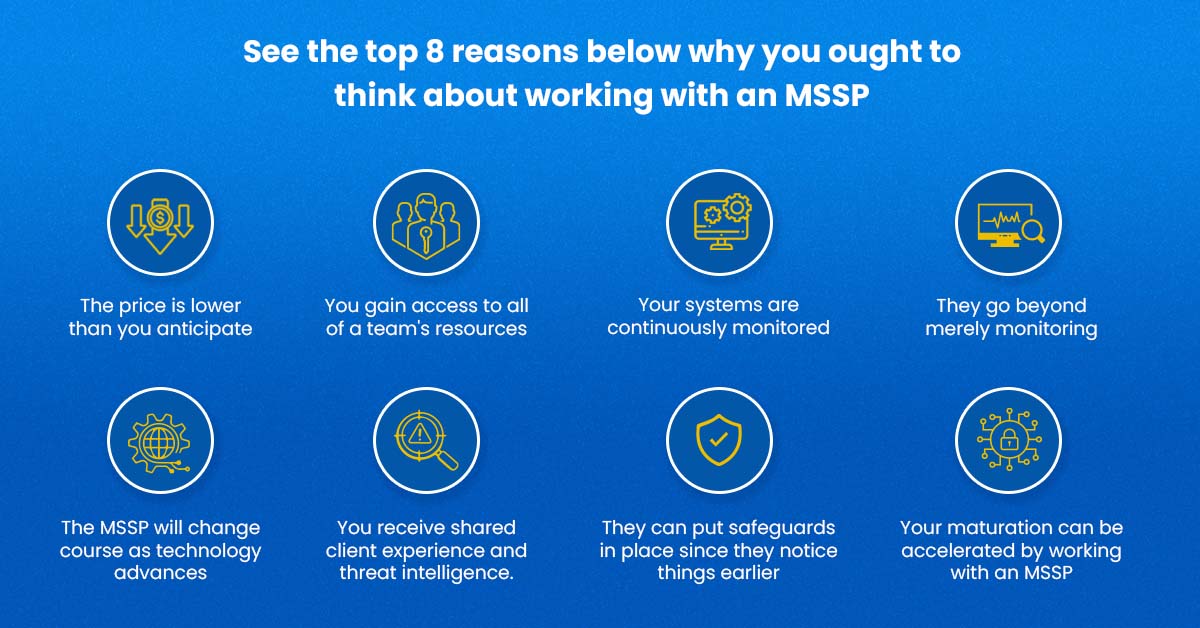
Top 8 Reasons to think about working with an MSSP
  • The price is lower than you anticipate

There is a widespread misconception that using an MSSP is expensive and exclusively for “big people.” Many smaller businesses assume that an MSSP will be beyond their price range, especially if it is onshore and offers round-the-clock monitoring. However, MSSPs are able to spread the expense of resources over a lot of clients because they look after numerous clients. Additionally, the majority of MSSPs have either developed a solution using Open Source technologies to decrease the cost or have negotiated favorable pricing with their technology vendors based on volume license.

In the end, you should contact an MSSP to ask questions if you are thinking about one but are holding off because you are worried about the expense. It will probably turn out to be less expensive than you anticipated. Asking never causes any harm.

  • You gain access to all of a team’s resources

The majority of MSSPs divide their SOC into three unique teams. Level 1 does initial triage and continuously monitors. When Level 1 needs assistance, Level 2 handles the escalation of the problem, and Level 3 handles advanced escalations, incident response, and threat hunting. Five Level 1s, one Level 2, and one Level 3 are required as a bare minimum to run a 24x7x365 SOC operation, not to include the nice-to-haves of a SOC Manager and Threat Intelligence.

An MSSP will have a team of at least seven professionals watching over your network. You benefit from the expertise and understanding of an entire staff that has undergone rigorous training and has amassed years of professional experience.

Read More>>

Wednesday, 11 January 2023

A 360 Cybersecurity Approach – Maximum Security Minimum Risk

Technology is moving faster and advancing quickly, similarly, data is growing exponentially and in larger volumes. Businesses are investing strategically and financially to source the data, analyze it up to its potential, store it, and further action it. Throughout this process, security plays a very crucial role as any kind of threat or leak may cause severe damage to the business both financially and operationally. In the pandemic, the true potential of cloud and data centers has been witnessed by numerous organizations across sectors and across the globe.

360 cybersecurity approach

Thanks to this much-needed appreciation cloud industry have been moving higher up the growth ladder. Since maintaining an on-premise infrastructure and other security measures is quite complex, businesses reach out to third-party providers to not only store their data but also secure it and operate further. Present-day SecOps teams are alert 24*7 to discover, analyze, correlate, and gain the deepest insights into the suspicious threat data. The aim is for comprehensive threat visibility that goes beyond the tactical approach. Proper threat visibility is charted out via automated threat response and examined threat intelligence, both are considered crucial aspects of a cybersecurity solution.

In order to fight and prevent cyberattacks and threats, businesses need a proactive approach and comprehensive cybersecurity protocols in place. A 360-degree approach is among the surest ways to maximize data protection as a part of the cybersecurity approach. To tackle the threats, weaknesses, and vulnerabilities, the implementation of cybersecurity measures and protocols is done on corporate and digital levels. Basis the firewalls and the heavily equipped staff and physical surveillance, cybersecurity is measured. Businesses in the BFSI, pharma and healthcare segments are at higher risk because of the sensitivity of their data, hence they need more of an advanced protection system in place.

As hybrid work culture is settling in and digital transformation rapidly growing, cybersecurity attacks and breaches have become more prone. Between 2015 and 2021 more than 85 million cyber breaches were recorded. From grocery shopping, entertainment, educational classes, and banking, so much has led to our dependency on the internet, which means so much of our personal data is out there. Did you know, India ranks 3rd on the list of countries’ top internet users? Yes, that’s right we are 3rd in that massive list, just behind China and US. This means we need to increase and tighten our security measures in order to protect the exponentially growing data which is a crucial factor for growing businesses. A 360-degree approach can be beneficial in this unpredictable and competitive market as gives an exhaustive view for thorough planning.

Read More>>

Thursday, 10 November 2022

Why being cyber resilient is a must for your business

 As the globe is getting digitally connected, corporate systems are growing more vulnerable to evolving cyber security risks. High-profile security incidents continued to dominate news headlines in 2021.

cyber resilience for your business
cyber resilient for your business

Notably, we saw a concerning increase in ransomware-related data breach events, which increased by 82% in 2021. Attacks on the software supply chain rose by 650% over the course of the year as malicious actors deliberately pushed upstream to disrupt systems by infiltrating open-source software.

Business executives and IT teams need to approach cyber security with the attitude that “it’s not simply an issue of if an event will occur, it’s a matter of when” as they progress into 2022.

order to keep the operation of your company from coming to a complete stop, you must also think about how your systems will react to and recover from a catastrophe and also consider outsourcing with Security insight services that shield you from probable massive damage.

The idea of cyber resilience comes into focus at this point. This article will get you details about the idea and look at various strategies you can utilize to increase the cyber resilience of your company. We’ll focus on the function of backups in developing and putting into practice your cyber resilience strategy.

What is cyber resilience?

Cyber resilience is described as “the ability to predict, withstand, recover from, and adapt to adverse situations, pressures, attacks, or compromises on systems that use or are enabled by cyber resources”

cyber resilience
what is cyber resilience?

Consider cyber resilience as being “fit” or “primed” digitally. It involves maintaining your company’s data and devices online despite any security dangers that may arise.

Achieving true cyber resilience needs various techniques and levels of security for humans, systems, data, networks, and devices; it is not a one-dimensional or one-time effort. This tactic is frequently referred to as “defense-in-depth.”

Read More>>

Sunday, 2 October 2022

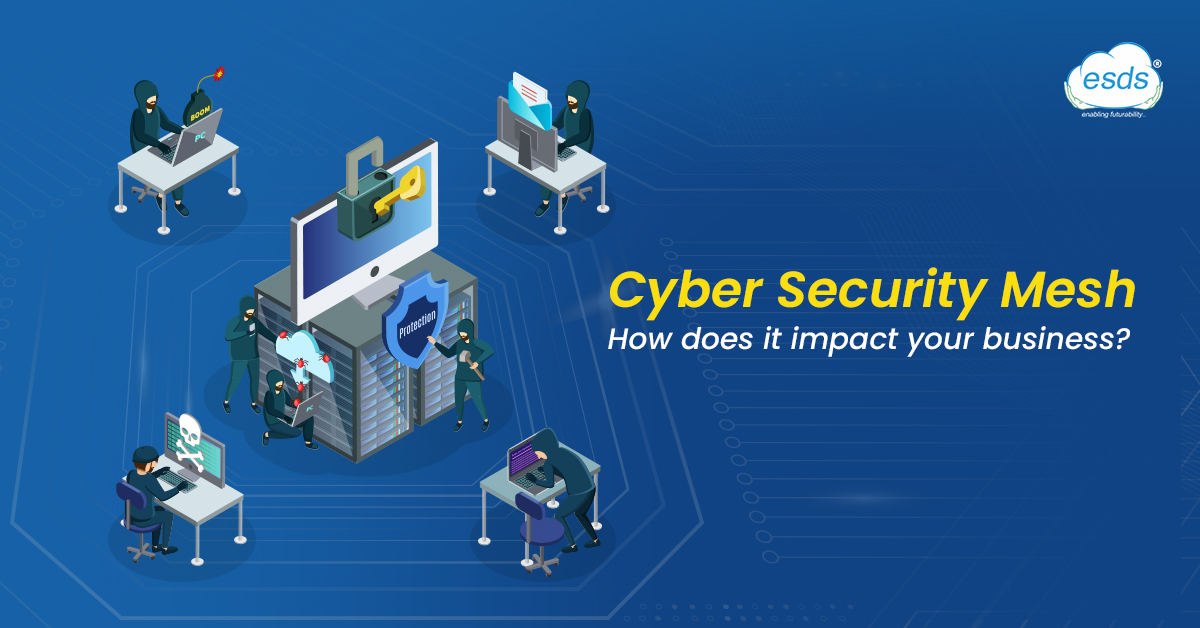
Cybersecurity Mesh – How does it impact your business?

As digital transformation is rapidly accelerating, more businesses are adapting to this current trend. Now the hybrid work environment is also catching up, organizations are faced with new challenges as we are steering away from the traditional network infrastructure. While the hybrid work model comes with its own set of comfort, flexibility, and productivity it also brings in certain risks and complexity. A majority of the staff is working remotely, and control over data and its security has become less rigid leaving the vulnerabilities exposed. Now how to keep the security intact and not let the vulnerabilities prone to hackers? Cybersecurity Mesh, which acts as a cyber-defense strategy with a more holistic approach. While regular security practices use a single perimeter to secure an entire IT environment, Cybersecurity Mesh on the other hand secures each device with its perimeter independently. 
Cybersecurity Mesh

The traditional network perimeter has now become a diverse network that manages infrastructure, remote machines, and their uses, cloud technologies along with IoT devices. Organizations that are adapting to this approach with their remote work model gain access to data and more control over policies implementing new technologies. Industries such as banking, manufacturing, or government are still very much following the traditional practice. Businesses of larger sizes have complex IT architecture hence they need a more distributed model. To run the business smoothly in today’s competitive market organizations are inching more towards a data processing edge and relying on multiple cloud implementations.

Read More>>

Thursday, 27 August 2020

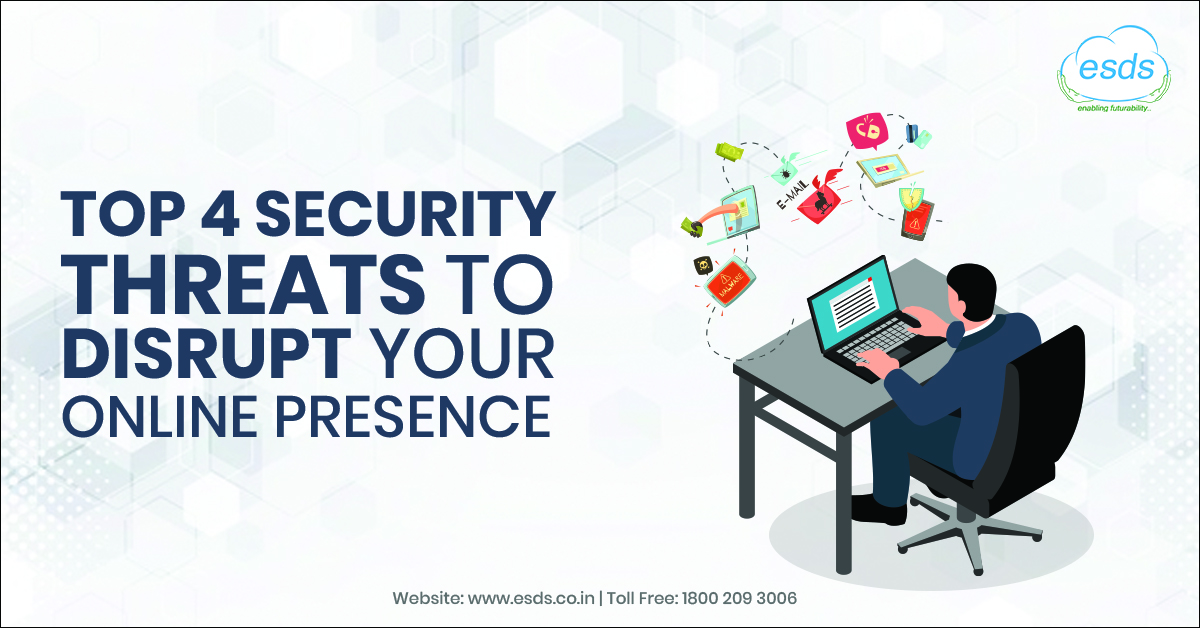
Top 4 Security Threats to Disrupt Your Online Presence

In this digital era, businesses have incurred huge losses due to the sophistication of cyber-attacks and a growing number of security breaches. Maintaining pace with the threat landscape is a common pain point the cyber experts are facing. According to a survey, Data breaches exposed 4.1 billion records in the last six months. Website security continues to be a major concern with the rapid growth of businesses relying on IT infrastructure.

Top 4 Security Threats to Disrupt Your Online Presence

Let’s have a look at the security trends ready to disrupt your online presence:

  • The Rising Threat of Data Breach

Since the business data has enormous value in the black market, it remains the prime target of hackers. The increasing graph of data breaches has shaken the business world with website security turning out to be a major concern for businesses.  A data breach in your organization will incur a huge loss to your business with the loss of customer loyalty, revenue downfall, and negative brand reputation.

Threat of Data Breach

Regular security audits secure your online presence from a data breach. Vulnerability and compliance management will continuously monitor your IT assets to identify gaps and security misconfiguration in your physical and virtual environments. Allowing your security team to understand the security risks of the working environment will help you to proactively mitigate the data breach.

  • IoT Vulnerability

Over the years, we have seen mobiles being vulnerable to attacks. In the present scenario, with the increasing proliferation of the Internet of Things, organizations relying on IoT devices are even more at risk. They offer a plethora of potential vulnerabilities like insecure Wi-Fi networks, hard-coded credentials, and unencrypted data. A compromised router serves a platform to launch a massive number of attacks through IoT devices. The organizations automating their processes with the Internet of Things need to secure their web assets. 

Read More>>

Thursday, 13 August 2020

Cybersecurity in the BFSI Sector Has Stepped Up Get to know why?

 What is Cybersecurity?

Cybersecurity may be defined as the act of securing every computing hardware as well as software that are connected by the means of an Internet connection or even cloud, in recent times. The cloud is gaining more popularity in line with positive business outcomes, it has also become prone to malicious entities and attackers who’re always looking to steal valuable user information.

Cybersecurity is a more technical term that corresponds to the physical security of systems present in data centers or any other computing system. Thus, there has been an increased demand for securing valuable user information. Cyber-attacks have now evolved into major threats for the BFSI Sector.

What Cyberattack Means in BFSI?

A cyber attack in the BFSI Industry opens doorways for malicious attackers along different channels. This could be a singular event where one person is targetted and his large amount of money or data is stolen using credit/debit card information, net banking, etc. If the attacker looks to target banks, then it is considered as a huge heist by the means of DDoS attacks, spear-phishing, ransomware, malware taking place on mobile devices to name a few. Governments across the world have emphasized heavily on strict security protocols and technology to stop these data breaches.

Read More>>

Monday, 10 August 2020

Determining Why SOC Services is important for your business

 Having the correct SOC Services Provider will help you in enhancing your business's cyberseurity posture and also providing real-time insights on various cybersecurity threats.


Sunday, 19 April 2020

Pharming – One of the deadly sins of online safety

In this digital age, as technological innovations continue to transform the world, cybercrime does its best to keep up. Just as one technique of cybercriminals is exposed and catered for, they move onto the next one.

“Pharming” is a typical example. The term “pharming” is based on the words “farming” and “phishing.”

It’s an advanced version of phishing where the victims are trapped without any particular bait for the same purpose as they are in phishing – stealing confidential information.


Wednesday, 15 April 2020

SSL SCAM: A FORM OF INTERNET SCAM – ESDS VTMScan

The internet contributes significantly to people’s lives these days, whereas the lives of some people evolve with time around the web. However, not everything on the internet seems real or seems as it is.

Just as the filmmakers use sophisticated tricks, manipulations, and effects to get us to believe that the action is real, so also there are numerous websites on the internet which are using a lot of tricks and great range promises to get the internet user part way with their cash or information for fraudulent acts.

The internet is full of websites that appear real on the surface but beneath it, its fake, fraudulent and scam -a ploy to fraud people
The evolution of the internet has brought with it numerous extremely convenient advances and powerfully shaped our manner of livelihood. The world is a global village. At the same time, the evolution of the internet has also given way to new risks and methodologies to prey on internet users —new avenues for online scammers to rip off the unsuspecting users